- Acknowledgements Page -
© 2006 Andrew McQuade
Part One
Introductions and Theoretical Concepts
GENRE AND THE AUDIENCE:
PRODUCER, TEXT, RECEIVER
The idea for this research
project began when I read Rick Altman’s Film/Genre some years ago. In
his book, Altman gives a highly comprehensive insight into the concept of
genre in relation to film. He traces the concept of ‘genre’ back to
pre-literature and attempts to give an overview of the evolution of the
concept, ultimately leading to our current understandings of the term.
Chiefly, he examines the institutional requirements and benefits of ‘genre’ as
a marketing tool, and in particular the role critics play in shaping genres
over time. For Altman, genres are chimera entities, forever going through a
process of commercial recycling.
Altman’s book raises the
question, ‘if a genre cannot be said to be an objective construct, rather a
complex social construct that occurs over time, how can it possibly be useful
to commercial investors let alone scholars?’ Wouldn’t producers logically
prefer to invest in ‘solid’, ‘dependable’ and ‘objective’ projects rather than
some obscure pro-morphic entity? Whilst scholars have celebrated poly-generic
texts, from various theoretical perspectives, this has often led to a lack of
concern towards a text’s institutional requirements. For example, a film may
be abound with elements of genre mixing, which may receive artistic praise
from scholars using auteur theory, however, we must bare in mind that any
‘artistic’ auteur still has to fit industry standards. They still have to make
money and work as part of a huge team, through the many stages of production.
In Altman’s view, the role of
the critic is to shape the way genres are received, for it is their
‘enlightened’ perspective on a film’s ‘objective properties’ that ultimately
prepares, or suggests, interpretative viewing strategies for the consumer. For
Altman, genre today is a constant reinvention process, where ideas are
recycled rather than an invented (Altman, 1999: 34), but he does not comment
on how this affects the interpretational strategies of the folk consumers.
Altman deals with the ‘film’ in
Film/Genre more than the ‘genre’. This made me wonder, if we take
Altman’s ideas to another medium; are the roles of industry and critic so
pronounced, and do they function in the same way? The critic and the marketers
may shape the discursive framework by which generic texts appear in the public
sphere to an extent, but what input does the consumer have and what of a
text’s creators? Are they no more than names on a poster, dehumanised into
nothing more than figments of some capitalist agenda? Altman employs no
audience research to give insight into their particular input into ‘the genre
game’. Rather, they are there, by implication only, to consume both the text
(as supplied by the producer) and the context (as decreed by the critic and
marketing forces). Altman neglects, as does so much genre theory, the
vernacular. The day-to-day folk who consume texts, their vernacular theories
about them and practices of consumption, are ignored and the relationship of
these folk to a film’s producers is textual at best.
Thomas McLaughlin parallels
vernacular theories to Foucault’s “subjugated knowledges,” those knowledge
types that are subject specific, but not to the established standards of the
hegemony (McLaughlin, 1996: 7). Not only are the folk consumers ignored though
in Altman’s theory, I would argue that the producer of a text has become
naught but a dehumanised industrial construct. The vernacular does not apply
solely to audiences, as subjugated knowledge types occur everywhere in our
society, including producers. McLaughlin calls this particular knowledge
‘insider theory’ (McLaughlin, 1996: 102).
Why should any of this be of
interest? Within popular music, the grunge movement appeared in the late
eighties in stark contrast to ‘poodle hair rock’ which dominated the
mainstream at the time. We can surmise, or theorise as some academics have
mislabelled it, that grunge’s popularity was due to its counter-mainstream
aesthetics, but without being within the musical culture of the time, we can
do no more than surmise. We need to understand the consumer viewpoint from
within, to find out why it is that such seemingly random genres appear from
out of nowhere and find success, but we also need to understand the
perspectives of such bands themselves.
Ethnography has proved a
popular method of scholarly enquiry when investigating culture and
sub-cultures of all types. A record company’s sales statistics may give a
quantitative indication of what is popular, but they can never explain why.
Karen Halnon, in ‘Inside Shock Music Carnival: Spectacle As Contested
Terrain’, uses multi-textual ethnography as a means to discover what the music
of ‘carnivalesque bands’ such as Slipknot and Insane Clown Posse mean to the
fans themselves, and how such music is important in their every day lives and
is important in their formulation of self identity through ‘commodified
rebellion’(Halnon, 2003: 774). Importantly, Halnon’s investigation is one that
uses interview excerpts to back up her claims, not just random theorising. The
every day meanings within a culture, such as the ones Halnon investigates, is
something ethnography seeks to understand. For Spradley:
The essential core of ethnography is this concern with the meaning of actions
and events to the people we seek to understand. Some of these meanings are
directly expressed in language; many are taken for granted and communicated
only indirectly through word and action. But in every society people make
constant use of these complex meaning systems to organise their behaviour, to
understand themselves and others, and to make sense out of the world in which
they live. These systems of meaning constitute their culture; ethnography
always implies a theory of culture (Spradley, 1979: 5).
Halnon, a fan of many of the
bands whose culture she investigates, uses excerpts of bands’ lyrics to
demonstrate how they allow fans to identify with a band, which helps in the
fan’s formation of self identity. She validates this against interviews with
several concert goers at ‘carnivalesque’ music festivals. However, by only
examining the thoughts of festival participants, that suggest the musical
performers themselves are mere textual facilitators. They are almost
culturally extradited as human beings, representing only ideologies through
‘spectacle’ (Halnon, 2003: 751 – 753). This is a problem that needs
addressing. Referring to online fan groups, Nancy Baym notes that
“[s]cholarship so far has barely scratched the surface of the interplays
between media producers and online fans” (Baym, 2003: 247). Jenkins suggests
that “[r]ather than talking about interactive technologies, we should document
the interactions that occur amongst media consumers, between media consumer
and media texts, and between media consumer and media producers” (Jenkins: n.d.)
As such, this Dissertation asks ‘what can be learned by looking at
producer/consumer relations in cyberspace?’
Reception studies emerged
partially as a reaction against dominant forms of textual analysis, where the
scholar’s enlightened wisdom would unlock the hidden meanings of a text. By
placing the emphasis less on the texts ‘intrinsic properties’ and more on the
marketing of texts and what texts mean to audiences, a greater level of
meaning could theoretically be unlocked which was not subjective solely to the
scholars’ interpretation (Staiger, 2005: 3). However, this shift in emphasis
occurs for reasons of practicality also, which are seldom admitted. A scholar
investigating the release of War Of The Worlds (Spielberg, 2005) cannot
just call up the director and ask him questions about the texts production. As
such, scholars practising Reception theory, such as outlined in Staiger’s
Media Reception Studies, can only examine the last few parts of the chain.
This has led them to imply the needs of the textual producer without any
verification at all, just as textual analysts fail to verify their claims with
actual audiences. We need to look at both producers and consumers to readdress
the balance.
The problem with such a
proposition is the amount of variables it requires the researcher to be in
control of. It requires the researcher to be present at the birth of a new
stylistic genre movement, to be able to integrate into the culture surrounding
it, and to be able to research it competently by having access to text,
consumer, and producer. Luckily, I am in such a position. The Swedish band
Machinae Supremacy (or ‘MaSu’ as abbreviated by their fans, hence the term I
shall use) achieved great success at an underground level in the five years
since they started making music. They produce a style of music that is
recognisably rock orientated, but distinctly different from other styles in
either the mainstream or the underground, incorporating musical influences
primarily from computer games.
I do not claim their music is unique from a musical theorist’s perspective,
and I should stress that my theoretical background is not within this field.
This claim I make from my own vernacular knowledge of rock/metal culture, but
as I hope to demonstrate later in my research, this view is more than verified
by other members of MaSu’s fanbase. I wanted to find out how and why a band
that plays a style so generically unlike other bands has gained a loyal
fanbase, by examining the producer/consumer relationship, shifting the
emphasis away from the textual elements except where referred to in
producer/consumer discussion.
With so many independent
musicians, film makers, and other artists turning to the Internet to express
their creativity, I hope my research will be able to demonstrate how artists
can be successful independently in new media environments, and that aesthetic
conformity to the standards of the industry need not be a pre-requisite. Such
research then, is of more than just academic importance.
My Dissertation is split into
three key sections:
- In part one, an overview of
various theoretical issues which first need to be addressed.
- In part two, I will consider
the results of the ethnographic part of my investigation. Using virtual
ethnography (sometimes referred to as ‘cyber ethnography’). The object being
to understand the band’s reception by looking at producer/consumer
interaction.
- In part three, my conclusion
will highlight what has been learnt by ethnographically looking at online
producer/consumer relations.
ETHNOGRAPHIC BOUNDARIES, ETHICAL ISSUES, ONLINE SOCIAL
HEIRARCHY AND ‘HCMC’
What makes MaSu so accessible
to an Audience and Reception Studies scholar is their almost exclusive online
marketing. The band have made hundreds of free mp3’s available on the
Internet, done online interviews, participated in IRC
sessions, and they host their own forum where they interact with their growing
global fan base. They have openly allowed fan production including desktop
wallpapers and song remixes. They engage in discussions with their fans on a
wide variety of topics not always musically related. With the Internet so
vital to the band’s reception, they are a highly practical research entity. As
Christine Hine suggests:
The ethnography of the Internet does not necessarily involve physical travel.
Visiting the Internet focuses on experiential rather than physical
displacement. (Hine, 2000: 46)
As a researcher I can access
the majority of the band’s musical texts legally via mp3, and view/participate
in social interactions, on the official forum. The MaSu official forum allows
for a culturally specific understanding of both sides of textual divide.
A forum is a place online where
end-users can post comments on topics of their choice in a ‘thread’. A forum
is usually designated to one parent topic, with several sub-sections
discussing various areas of said topic. Once an end-user has navigated their
way to the sub-section of their choice, they can create individual threads or
post in existing ones. In a thread, other end-users can then add their own
comments, taking discussion into directions that can sometimes be far removed
from the initial subject. Discussions on a forum differ from ‘live’ chat rooms
using JAVA script, in that forum discussions are always turn based and do not
allow for real-time video/audio conferencing. Some forums allow for anonymous
posting, but on MaSu’s forum, all end-users have to sign a ‘terms of
agreement’ declaration before joining, to make them members of this ‘virtual
community’. Virtual Communities, according to Howard Rheingold, the inventor
of the term, are “social aggregations that emerge from the Net when enough
people carry on public discussions enough, with sufficient human feeling, to
form webs of personal relationships in cyberspace” (Rheingold, 1993: 5). As
such, I am working from the concept of the likes of Anderson, that communities
do not require face-to-face, or rather body-to-body interactions. Communities
exist in the conscious, rather than the physical (Anderson, 1983: 18).
Much of the issue’s around
Internet research ethicality centre around the ‘Internet as public versus
private zone’ debate. The forum is a public zone and all chat that occurs on
there can be considered ethically researchable, based on the fact that
end-users can choose to send private messages to each other, which are not
viewable by the public. This means that whilst some data is always concealed
from the ethnographer, since this data is sent privately, it would not be
ethically researchable anyway (Stern, 2003: 251). I have divulged some private
messages addressed to me during this research, because they were at my liberty
to reveal and did not contain anything incriminating about the end-user who
had sent it to me. It is impossible to provide citations for these comments as
they are only accessible from my personal log-in, but in orally based
ethnography such citations are rarely available at all, beyond the word of the
scholar.
Whilst not all forums are
designed for leisure purposes, in the case of the MaSu forum, this
cyber-environment fits Radway’s description of the ‘leisure world’, being
“conceptualized as sites for the pursuit of what are still referred to as
‘merely’ hobbies or avocations, they are increasingly and ironically the very
realms in which individuals invest most of their energy, money, and time” (Radway,
1988: 370). Building on the concept of the Internet as hyper-real, or
hyper-textual, environment (Livingstone, 2004: 80), we can see forums as
‘hyper-leisure worlds.’ Because of MaSu’s presence on the forum, these leisure
worlds can also been seen as the site of producer/consumer vernacular
relations. Radway seems to hint at the significance of this in the closing of
her essay, when she questions “perhaps it might also be possible to identify
together those points where articulations and alliances could be forced across
the borders in the service of a future not yet envisioned and therefore
neither necessarily lost nor secured” (Radway, 1988: 374).
Dennis Waskul and Michael
Douglas, in ‘Cyber-self: The Emergence of The Self in On-line Chat’ use the
term ‘cyberself’ to refer to the self identity of the end-user and suggest
that “a cyberself is always whatever is passing for a self at the moment in an
electronic-computer-mediated context” (Waskul & Douglas, 1997: 375) From a
research ethics point of view, end-user anonymity is of vital importance. Were
it possible to trace an end-user’s comment to their location in the offline
world, an ethnographic investigation such as mine could not take place.
Fortunately, the IP address of an end-user’s computer is not accessible to
other end-users on the forum. End-users are in control of how much information
they reveal about their ‘real identity’, and any incriminating information I
have not included in this paper. I do not regard any of my research as
harmful, nor would I conduct it if it was, thus the ethical issue of
dishonesty/harm is not present. I made end-users on the forum aware that I was
in the process of writing this paper.
A ‘moderator’ is an end-user
selected because they appear to be capable of holding a responsible position,
and who is entrusted with more power than standard end-users. Such powers may
include the right to close threads indefinitely (‘locking’), censor comments,
and even ban users if comments are derogatory or discriminatory. Depending on
how strict a forum is, moderators can also make sure discussions do not stray
from the initial thread topic. In this respect, they direct the flow of
end-user exchange to a degree.
All forums then, have power
relations and social hierarchies like in the ‘real world’, however they are
not necessarily alike the ones in the real world. Within virtual ethnography,
traditional social norms become contorted and the participant/observer duality
becomes much more confusing as the line between reality and hyper-reality
becomes increasingly blurred. An end-user can be logged in for hours and never
make a single comment, thus being present within the folk group of the forum,
but not contributing to human computer mediated communication (HCMC).
This is known as ‘lurking’.
It is arguable that simply by
the scholars presence, he or she is contorting the social world, so as to
create records that do not capture the ‘natural cultural environment’.
‘Lurking’, if we follow said logic, is a method by which to observe social
interaction without such ‘contamination’. I take issue with the notion that
there can ever be such a thing as ‘naturally occurring’, or ‘intervention
free’ data. Not only is the word ‘natural’ extremely ambiguous and wrapped in
ideological assumptions, but in my instance, I have been a member of MaSu’s
forum long before I began writing this Dissertation. For me to not be
interacting on the forum would be equally corruptive to the so-called ‘natural
order’. Ethnographically speaking, to extradite myself experientially from
social interaction would be to not fully capture the vernacular meanings of a
culture, which would be methodologically un-sound.
Henry Jenkins’ investigation
into the alt.tv.twinpeaks newsgroup is one of the pioneering investigations
into online fan culture and consequentially HCMC. In his piece, Jenkins
focuses on the HCMC elements most akin to normal talk though. That is to say,
text is just seen as text, with little mention of the way text is contextually
altered by the advent of the Internet. Nonetheless, his investigation has been
particularly influential for me, in the way he picks out key motivating themes
and ideas that appeared in the HCMC he observed. In his work, some end-users
suspected that Twin Peaks creator David Lynch was present on the
newsgroup and trying to mislead them (Jenkins, 1995: 59). Here the
producer/consumer relationship is implicitly acknowledged. In my research, it
is explicit by virtue of the fact that MaSu themselves are active members of
their forum.
The problem with ‘text centric’
interpretations of HCMC is that, like in discourse analysis, the visual cues
are filtered out. Whilst an end-user is never aware of other end-users facial
expressions like in oral communication, words accented or written in capitals
take on different meanings online. In addition, forum avatars,
signatures,
use of visuals and sound are all elements contributing to HCMC and an
end-users online identity. The semantic dimension of HCMC is not the same as
in the ‘real world’ and an online ethnographer must be aware of this. Virtual
ethnography is about more than just simulacrums of ‘real’ language.
I do not wish to suggest that
MaSu are not discussed elsewhere on the Internet besides their forum as they
are discussed on other forums relating to the rock/metal spectrum as well as
forum relating to gaming culture too. However, the potential number of sites
hosting HCMC discussions exceed the thousands, and it is virtually impossible
to find the online locations in which the band have been discussed. Ultimately
though, their official forum is the only place I can research
producer/consumer HCMC exchange. My research into MaSu often led me to look at
other related websites cited by the folk of the forum. I do not see this as
transgressing the ethnographic boundaries I have placed, by researching
outside the forum. Rather, in viewing other MaSu related sites, such as their
unofficial FAQ, I am participating in an activity shared by other members of
the online community.
I already have a certain level
of vernacular knowledge of what it means to be a MaSu fan and there is a
danger of taking for granted issues which should be subjected to ethnographic
scrutiny because of this. However, I believe my vernacular knowledge about
MaSu means I have less gratuitous amounts of new information to take in,
compared to someone completely alien to the band. A major benefit of the
ethnographic approach is that it removes the ‘clinical’ nature of the focus
group and provides greater potential for the scholar to be genuinely immersed
in a cultural environment, rather than moderating a discussion from some
mythic ivory tower of academia. Whilst it is theoretically possible to use a
forum as an online focus group, this requires the scholar to behold the power
of moderation, thus drastically altering social hierarchy. The results is that
a focus group can certainly examine the vernacular, but it cannot experience
it. To understand a culture from within, it is necessary for the scholar to be
on the same level as the folk. Schrøder et al, in Researching Audiences
summarise the Malinowskian position that:
[T]he ethnographer should study culture not just from a bottom-up perspective,
but from an insider’s perspective, an aim that demands committed, long-term
immersion into a setting in order to understand how meaning is achieved and
attained. Moreover, the ethnographer should study culture from a holistic
perspective (‘his world’), an aim that demands equally committed analysis of
multiple view and often contradictory sources in order to understand how
meaning is constituted as contextualised practices (Schrøder, 2003: 65).
As such, we gain more from
seeing the producer/consumer interaction as being from different sources
within the same cultural sphere, rather than intrinsically oppositional. This
pre-determined opposition between fans and producers, as seen in other work on
fan culture, I take issue with. I will outline why in the next section…
HENRY JENKINS, THE GUERILLA AUDIENCE, AND THE
POST-MODERN VISION OF ‘THE INSTITUTION’
Be it a ‘dot com’ mogul, record
producer, or a film company; in all such instances the ‘producer’ is usually
seen from a perspective that projects the image of the greedy capitalist
producer who relates to the consumer only as a human embodiment of financial
capital.
An example of the ‘producer
versus consumer’ relationship is echoed in the work of Jenkins, who in
Textual Poachers, brings up this issue in his in-depth discussion Star
Trek fans and their production of ‘filk’ texts, noting how fans rebuke
established power relations in producing their own fan-fiction. Employing
DeCertauian ‘tactics’ (as opposed to the ‘strategies’ of the empowered
institutions), fans produce texts that develop ideas and character
relationships not seen in the TV show (Jenkins, 1992: 33). These fans
selectively poach from official texts to satiate their own needs. Jenkins’
view of the producer/consumer relationship is a step up from the factory
worker being exploited by the corporate ala Marx, but Jenkins still sees the
fans relationship to the producer as defined by resistance to the hegemony
(Jenkins, 1992: 40).
Barker, in Knowing
Audiences: Judge Dredd, speaking of pre-deterministic social research,
notes that “[t]here was research which seemed to show that witchcraft existed,
and which had powerful effects – but in the eyes of those who scorned and
attacked it, that was because it was so designed that it was bound to find ‘witches’”(Barker,
1998: 84). By selectively looking for information with a set interpretative
strategy at the ready, witchfinder generals parallel some academic researchers
more often than we would like to admit. Whilst Jenkins’ insights are valuable,
and may well be correct in regard to the fan group he investigated, he is
guilty of never looking at the other side of the textual wall. By seeing the
producer/consumer as two entirely segregate entities operating within the same
sub-culture but diametrically opposed to one another, a relationship is
imposed on them, which has resulted in a producer/consumer relationship within
fan studies as being pre-determinately hostile. Radway seems to advocate
readdressing this balance throughout her essay ‘Reception Study: Ethnography
and The Problems with Dispersed and Nomadic Audiences’, stressing the need to
examine producer/consumer relations, noting that “[t]o think of someone as a
listener or receiver in an audience, obviously, we must first assume the
existence of the speaker/producer” (Radway, 1988: 361). More importantly,
that; “the words separating ‘us’ from ‘them’ are not natural boundaries, but
social borders of our own making” (Radway, 1988: 374). However, as she further
outlines her research proposal, it appears that she too predetermines the
producer/consumer relationship from the outset:
I suggest a study of the production of popular culture within the everyday as
a way of trying to understand how social subjects are at once hailed
unsuccessfully by dominant discourses and therefore dominated by them
and yet manage to adapt them to their own other, multiple purposes and even to
resist or contest them [my italics] (Radway, 1988: 368).
Whilst I am not attempting to
discredit the work of those theorists who have looked at how audiences reject
‘hegemonic meanings’, I would argue that the issue of ‘meaning’ itself has
become less a case of semantic interpretation, more a case of semantic war.
The work of Fiske has been particularly influential in advocating this
perspective, but as Dhalgren notes “he makes too much of the ‘resistance’ to
hegemony that alternative interpretation of popular programmes might entail” (Dhalgren,
1998: 300). Further noting that “[O]ne’s point of departure and interests
shape to some extent the notion of ‘audiences’, and one thus conceptualizes
‘audiences’ within particular discursive settings” (Dahlgren, 1998: 307). I
would suggest that the language of warfare, epitomised by the likes of
DeCerteau’s ‘Guerilla viewer’, does not generally reflect fan culture from a
fan’s, or even producer’s, point of view.
Textual Poachers
drastically changed previous academic preconceptions that fans were nothing
but passive, if slightly quirky, textual consumers. However, the dualistic
division between Star Trek’s producers and its fans, as Jenkins sets
them up, puts them in opposition to the extent that one would almost be
inclined to believe the makers of a show like Star Trek had no interest
in the show at all. In seeing fans as passionate, intelligent, and committed,
the producer, by contrast, has become a tyrant. There are several possible
reasons for this, and I would suggest that the main one is the dominant
modernist perception of the institution. The producer/fan oppositional
relationship is essentially a modernist construct. With modernisms need for
hierarchies, social order, definable boundaries, constant and objective
segregation, a producer/consumer relationship characterised by conflict does
not seem an unlikely outcome. The reason being, that the ‘organisation’ is so
vast, so concerned with its own structure and segregation, that the consumer
can only exist as a commercial statistic (Styhre, 2001).
Styhre, in ‘Nomadic
Organization: The Post-modern Organization of Becoming’, discusses the
‘nomadic organisation’ as one that is constantly on the move, always seeking
to branch outwards, not constricted by boundaries, and, perhaps most
importantly, where the boundaries between the internal and external become
blurred. As he notes:
In a post-modern capitalism, there are nothing but fluxes, breaks, changes,
and bifurcations; the organization thus becomes an open system with close
relations with the environment. The boundaries between inside and outside are
continuously transgressed. As a consequence, a pluralist epistemology of
becoming is needed, an epistemology that acknowledges a polyvocal and
polysemiotic view on the organization (Styhre, 2001).
Whilst I would not go as far as
to call MaSu a ‘nomadic organisation’, there are clear benefits to Styhre’s
model. In such a model, the producer and the consumer are no longer at war on
the battlefield of textual production/consumption. The Internet has forced
scholarly redefinition of social boundaries and problematises modernist
notions of segregation, with its blurring of real and hyper-real environments
(Waskul & Douglas, 1997: 378 – 379). It openly allows for such a post-modern
view of the organisation. Whilst Styhre still seems more concerned with the
modernist view of the ‘mammoth organisation’ in his piece, he at least affords
the potentiality to see the organisation as something other than
Godzilla-like. The institution can conceivably be a ‘local’ phenomenon. With
the fan already established as an example of Foucault’s ‘localised power’ or
Tulloch’s ‘powerless elite’, we can now see the creator of a text and the fan
as compatible entities, with the producer not necessarily exclusively
segregated by capitalist prerogatives as he/she/they sit in a gigantic
skyscraper.
Even with Styhre’s model, it
would be foolish to suggest Jenkins’ research and mine are directly comparable
for there is a big difference in scale. Star Trek is a mammoth
enterprise with directors, writers, producers, marketing people, and Paramount
Pictures executives all involved in the process of turning the Star Trek
name into profit. It fits the modernist model perfectly. MaSu, conversely,
sell all their own merchandise through their own label ‘Hubnester Industries’,
accessible online. They are textual producers, performers, money men, a rock
band and rock fans all at the same time. This is not to suggest hierarchy is
suddenly extinct in the world of MaSu, but it does not exist exactly like in
Jenkins’ example. MaSu are subject to copyright just as much as Star Trek,
but we need to conceive the potentiality of a producer/consumer relationship
that can be more intimate, a horizontal relationship as well as vertical, not
just the latter.
Critics of this position would
no doubt point out that an intimate producer/consumer relationship is
farcical, an illusion brought about by the identity of the ‘end user’ within
new media. It is capitalist greed under a newer, more technologically friendly
guise, fooling end-users into thinking they have more power than they do
(Weinstein & Weinstein, 2000: 200). Within the technocapitalist model of Best
and Kellner, such a position is certainly viable. In their model, the Internet
allows the previously impossible potential for unlimited and rapid trade (Best
& Kellner, 1997: 58). The producer/consumer relationship is defined by low
cost production, but high financial intake at unprecedented speed (Styhre,
2001). The model suggests rapid-fire capitalism is the sole benefit of new
communication technologies, with the distance between producer and consumer
kept the same as in other traditional modernist models. It does not consider
that new technologies bring greater communicative discourse into play, in
addition to faster exchange of commodities. It has almost become second nature
to see a capitalist model as being devoid of human interaction at all, let
alone a realm in which the term ‘vernacular’ seems applicable.
Whilst it may be true that
categories like ‘producer’ and ‘audience’ are created through the process of
production/consumption (Hine, 2000: 38), within different theoretical
discourses, these can carry very different meanings. The ‘producer’, the
‘industry’, the ‘institution’, and the ‘organisation’ all carries the image of
some mammoth, almost mythic, monster whose appetite for consumer exploitation
is insatiable. Whilst audiences have long since been liberated of their
damaging image as mere passive mass consumers of texts, the producer is still
a very ambiguous term, and one that nonetheless carries predominantly negative
connotations, particularly to those with Marxist leanings. For the purpose of
this Dissertation, let us see the following terms defined as overleaf:
·
The producer from here on refers to the textual producer. In the
case of MaSu, they are their own marketing force, musical performers,
moneymen, and function in several other roles. The producer here encompasses
all these.
·
The end-user is a particular type of audience which should not
be confused with the ‘mass’ television audience, nor should it be confused
with the individual novel reader (Livingstone, 2004: 75 – 77). Where forums
are concerned, the end-user is an active participant in the creation of a
textual world. There is no passive end-user, for even the ‘lurker’ practises
computer mediated interaction of a kind. It differs from previous notions of
the audience in that whilst the end-user is situated within the ‘real’
offline, he/she appears online as a simulacrum of the ‘real self’ within the
hyper-real environment of the Internet (Waskul & Douglas, 1997: 380).
Having established the
necessity for an ethnographic approach, the following issues need to be
investigated by looking at the MaSu community as a whole, not treating
producers and consumers as separate social entities within one virtual
setting:
1.
How important is the forum in establishing and maintaining
producer/consumer relations?
2.
What vernacular discourses mediate on such forums and how are they
maintained?
3.
What is the significance of ‘genre’ as a discourse?
4.
What are the etic/emic qualities within the MaSu online community?
5.
How does talk around the discursive object (the band) function within
the forum environment, how are opinions expressed, and what areas are taboo?
6.
What social hierarchies are observed and how do/don’t these differ
between producer and consumer?
Within any research practise,
the position of the scholar is one that inevitably affects results. Even those
scholars who insist absolute objectivity is attainable would admit the
presence of the researcher always has a bearing on what is being researched.
For a scholar participating in an ethnographic study of fan culture, the issue
of being too immersed or too close to the discursive object is a problem often
debated. In the next section, I will discuss where I position myself within
the fan/scholar debate, my relationship to the band, and what I see can be
gained from this.
THE GOOD, THE BAD, AND THE UGLY or THE FAN/SCHOLAR,
THE SCHOLAR/FAN, AND THE POST-GRADUATE SOMEWHERE IN THE MIDDLE
In participant observation, the
dangers of being too close to the research object mean that research could be
flawed if the scholar is not able to mediate between participating in a
cultural setting and observing it to the correct degree. Where the ‘correct
degree’ is exactly, is of course subjective and appropriate to the uniqueness
of each cultural encounter. Ethnography complicates this even further, by
requiring the scholar to see things through the eyes of cultural participants
themselves. It incorporates an experiential dimension to the proceedings,
which is an integral part of meaning making. When studying a fan culture,
there is the added problem of the scholar already having personal investments
in the object of study and even pre-existing investments in the culture being
studied. I hold no delusions that I am exempt from these issues and thus need
to address them, my place within the scholar/fan dualistic argument, and my
views on what Matt Hills refers to as the inevitable ‘imagined subjectivity’ a
scholar in this situation faces (Hills, 2002: 3).
For Hills, the fan/scholar
dynamic is one characterised by a dualism that is not clear-cut. Where most
scholars perceive this dualistic divide purely from the academic perspective,
Hills suggests that fans too are aware of the divide, which leads many fans to
be sceptical and even cynical of academia. For Hills “[s]uch marginalisation
would suggest that fandom and academia are co-produced as exclusive social and
cultural positions” (Hills, 2002: 2). On both sides of the divide operates an
‘imagined subjectivity’.
For the scholar “[i]magined
subjectivity, we might say, attributes valued traits of the subject ‘duly
trained and informed’ only to those within the given community, while
denigrating or devaluing the ‘improper’ subjectivity of those who are outside
the community (Hills, 2002: 3). But as he notes, this devotion to rationality
and persuasion is contradicted by the multitude of opposing positions taken
with academia. Meanwhile, the fans ‘imagined subjectivity’ places him/her in a
position where he/she cannot account for his/her devotion to whatever the
object of their fandom is (Hills, 2002: 7). Such skills are only possessed by
the ‘good’ academic. I would suggest it is a gross estimation to perceive fans
are incapable of accounting for their devotion to a text, or that academics
are always able to articulate their pop-cultural investments with critical
distance. This implies all Academics have the ‘skills’ of those operating
specifically within the social sciences, which is not true.
McLaughlin in Street Smarts
And Critical Theory notes that fans often theorise in the same ways as
academics (McLaughlin, 1996: 6), but in a different cultural environment, with
what could be described, by the likes of Hills, as ‘different tools of
subjectivity’ to the scholar. Hills takes this a step further, suggesting
academic criticism can appear in fan discussions in the character of the
fan-scholar.
Hills’ comments on Steven
Frith’s important 1992 distinction between the ‘intellectual’ and the
‘academic’, identifying that whilst Frith suggests a distinction between the
two, he in fact uses the terms interchangeably (Hills, 2002: 6). However at
the same time there is ambiguity in Hills’ writings as to what ‘scholar’
means, versus ‘academic’. Within either fan-scholar discourse or scholar-fan
discourse, these lexemes seem to take on different meanings. ‘Scholar’, in my
understanding, refers to anyone using academic theory. Within ‘fan-scholar’
discourse, these are often ‘elites’ within fan culture. The ‘academic’ is
defined by a purely institutional position. As Hills notes though, both groups
share the same traits, the primary noun in the set defines the social
discourse by which action follows. For example, the academic-fan will not use
the same language in a lecture as a fan-scholar at a fanzine convention
(Hills, 2002: 20).
Hills finds it inevitable that
fans and academics oppose each other, because of the academic’s need to
‘translate’ vernacular theory into ‘proper’ theory. There is a gap here
however. Though Hills acknowledges there are fans who use academic theory,
many of them being ex-media studies for example (Hills, 2002: 18), he makes no
mention of where the undergraduate or postgraduate student fits in to his
work. Are these no more than fan-scholars simply because they do not work full
time in an academic institution? If the issue is not of knowledge, but of
social discourse, as is the running theme in Hills’ argument, this cannot be
so. The ‘student’ is a different social discourse to the ‘academic’, which is
different to the ‘fan’.
During my time on MaSu’s forum,
I found that I was one of many students (albeit the only one actively
researching MaSu). The fans did not ‘other’ me, or become intimidated by my
academic prerogatives, as Hills argues they are pre-determined to do. Rather,
in cases, they were enthused about my research and often wanted to know more
about it. The label of ‘student’ is different to the label of ‘academic’. It
affords the potentiality of an academic intellectual capacity, but without
being institutionalised. This affords me a greater level of mediation between
scholarly and fan prerogatives, for I am neither of these full time and am
subject to the corresponding associated social discourses only as and when
required. Whilst Hills is right to point out that vernacular knowledge needs
to go through a process of ‘translation’ to be useful within an academic
context, his argument that you are one or the other, with only an imagined
subjectivity as catalyst between the two, is uneven and I would suggest that
attempting to fit everything within a model of dualism is an inefficient
academic explanatory strategy.
This Dissertation is not a fan
study. Fans are but one particular social identity present on the MaSu
official forum, with a whole set of other identities, with complex social
relations, integral to the community. These dynamics, amongst many other
topics, I explain in Part Two.
Part Two
An Ethnographic Investigation of ‘forum.machinaesupremacy.com’
INTRODUCING
‘forum.machinaesupremacy.com’
When practising virtual
ethnography, one needs to first decide whether one is investigating the social
interactions conducted on the Internet directly, or the way in which social
mediations made practical by the technological advances of the medium itself.
The study of interaction between human and machine is termed ‘cyborg
anthropology’ by David Thomas, which can include interactions with other
humans when mediated through computers, but the emphasis is on human/machine
relations directly (Escobar, 2000: 62). Whilst this Dissertation is concerned
with more anthropocentric interactions, issues of medium and environment do
need to be addressed. Before I can discuss the producer/consumer dynamic of
the forum, and the presence of genre discourse therein, we first need to look
at issues such as:
- How the Internet changes
social hierarchical formation processes.
- How the social relations on
MaSu forum require us to reconceptualise the producer/fan dynamic.
- What forms of knowledge are
culturally specific to the MaSu forum.
From there we can address the
issues I put forward in Part One of this Dissertation. I have devoted a
section of Part Two to each of these issues.
Throughout this section I will
be referencing various sources of information collected
online. Some of these refer to
HCMC on the official MaSu forum, others cite websites such as the unofficial
MaSu FAQ and ‘Wikipedia’. In the case of the latter, data was small enough in
quantity to be able to print off and include in appendices (1) and (2). These
sources are notable because they exhibit useful vernacular knowledge about the
band, but also because they summarise the band’s history, providing a good
biographical introduction to MaSu if preferred by the reader.
When quoting end-users, I have
not acknowledged nor amended grammar inaccuracies. Online grammar differs very
much from offline grammar and to highlight online inaccuracies through the
lens of an offline scholar would be ethnographically un-sound. I have noted
edits however.
Figure 1, shows a screenshot
from the official MaSu forum homepage, the gateway to the virtual-community
upon which the majority of this Dissertation is based.
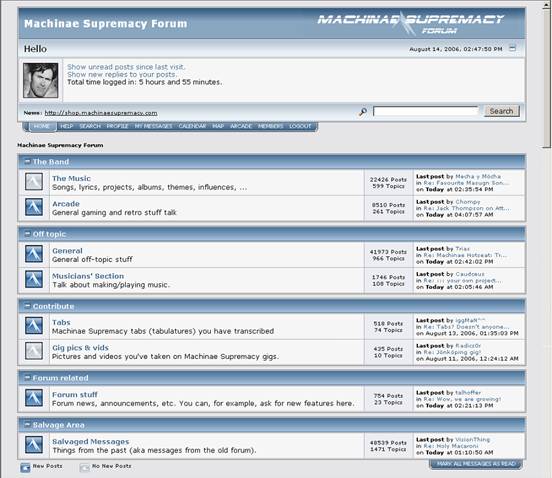
In figure 1 several major
headings can be seen, such as ‘The Band’, which is then further divided into
sub-headings. These are sub-sections of the forum in which one finds
individual threads. When sub-sections are broken down they form a chain such
as: ‘Machinae Supremacy Forum > The Band > The Music > The Newbies Guide To
Frequent Topics’. When referencing a thread, I refer to the last link in the
chain, the full citation of which is located as a footnote. Methodologically,
there is still no one approved way of analysing web-design, much less forum
layouts. However, where certain sub-sections on a forum are arranged can tell
us a lot about the discourses operating within a forum. For example, ‘The
Band’ includes two sections: ‘The Music’ and ‘Arcade’. ‘The Music’ is the most
active section of the forum, with more new threads appearing in here than any
other section. Under ‘The Music’, end-users can discuss the band’s music, like
we might expect on any rock band’s forum. ‘Arcade’ is an area designed for
discussion of computer/video games across all platforms.
By putting the sub-section ‘Arcade’ under the heading ‘The Band’, a link is
suggested between MaSu and computer/video gaming. The ‘Off Topic’ area is also
split into two sections. ‘General’, is for discussing anything unrelated to
MaSu or gaming. MaSu can still be mentioned here, but topics do not generally
concern them. The ‘Musicians Section’ is where end-users can talk about their
own music and the problems of recording, writing, singing, and playing music.
It differs from the ‘The Music’ thread because it does not relate specifically
to MaSu’s music, but the fans’ creations. Discussions are sometimes referred
back to MaSu here. In numerous instances end-users would ask how a particular
sound was achieved on a particular MaSu track. In such cases, these are
discussions of MaSu on a musically technical level, rather than as a leisure
interest. MaSu become an object of comparison for the folk to aid them in the
production of their own music. For example, in ‘Question
for the band (specifically Robert?)’, an end-user asked the band themselves
about a particular vocal affect he wanted to recreate:
On the Song "Gost (Beneath the Surface)" I'd really like to know how you did
the vocal effects. I've been trying to figure out how you do that, because
I've heard it in a few of the band's songs before, and all attempts at
recreating such an effect have failed. It's like a reverse echo/fade in on the
vocals. "I stand still out in the rain......" How it fades it on a reverse
echo on that part.
The band replied, and throughout
the thread they advised this end-user how best to recreate the desired sound
for his own music:
Well... I dabble with chorus, flanger, delay, and
more than once during the process i reverse the take and process it
backwards...
Nothing advanced, you'd probably be able to do that with one chorus plugin and
one delay plugin... Not counting EQ, of course.
The ‘Contribute’ section
contains an area for uploading guitar tabs of MaSu songs made by fans, and
also a section for uploading gig photos and videos.
Music ‘Tabs’ have their own
sub-section, implying a distinction from the previous two musically related
categories. This sub-section is for musicians who specifically want to be able
to learn to play MaSu songs, demonstrating that the band is actively
encouraging fans to make their own tab transcriptions of their music. Such
transcriptions might be referred to as ‘fan texts’. These are distinct from
‘poached texts’, as in Jenkins’ description (Jenkins, 1992: 28 – 33), as
‘poached texts’ imply a contortion in design from the hegemonic text, which in
MaSu’s case is the music they’ve released on CD or hosted on their website.
There are no ‘official’ transcriptions provided by the band, but the process
of creating a 100% accurate tab transcription is done by the fans with aim to
create a substitute for such ‘missing official’ transcriptions, not to contort
the original song.
The producers, in this
instance, facilitate both the primary text upon which tabs are based, but also
the social space in which transcriptions can be made available to the rest of
the MaSu online community. This section of the forum, in addition to the
‘Musicians section’, rebukes notions of the producer attempting to control fan
production. The official text and the fan text run side by side, not just in
the case of music tabs, but other fan creations like desktop wallpapers and
even covers of MaSu’s songs. I asked the band to clarify their position on
this particular issue, to which lead singer/guitarist Robert Stjärnström
replied:
We totally support fan creations. The fact that fans dedicate such time and effort into such things is purely positive, in my opinion. sometimes the result is some horrid
bastardisation of a song, and then it's almost painful, but it's still a good thing.
The final two areas of the
webpage are fairly self explanatory – ‘Forum Stuff’, concerning administration
issues and where end-users can make suggestions for the future of the site,
and ‘Salvaged Messages’. ‘Salvaged Messages’ contains threads from the
previous incarnation of the forum (before MaSu’s website was redesigned in
2006). Generally, threads from the old forum are not resurrected and newer
‘live’ threads are the most important to the community. The ‘Salvaged
Messages’ section is particularly useful for ‘newbies’ though, who want to
know about the history of the band without contributing to HCMC themselves.
This section highlights the problem of time as a discourse within forums, as
virtually any discussion can be revisited provided the thread has not been
closed or deleted.
Some end-users do not visit
particular parts of the forum at all. Most of the end-users I asked about this
said they were not interested in every section. Methodologically, I am not
concerned with which end-users visit which areas. I recognise the quantitative
possibilities of this issue, but that is outside the confines of this research
project. It is interesting to note which areas are the most active from a
qualitative perspective though. For example, ‘Forum Stuff’ is not as popular a
section as ‘The Music’. ‘Arcade’ and ‘General’ are also popular areas. The
consensus among the fans is that even though they can discuss topics other
than the band on the forum, it is MaSu that is their primary reason for
joining the community in the first place.
Having established the
structure of the MaSu forum in terms of its layout, I wish to now direct
attention towards structure of a more social nature, identifying how issues of
hierarchy and identity work online. This is necessary to gain a contextual
understanding of the discussions between producer and consumer that I shall be
discussing in depth later. All folk groups are affected by their environment
and an ethnographic investigation must account for this, whether it is being
conducted in reality or ‘virtuality’.
AVATARS, ONLINE IDENTITY,
AND HEIRARCHY
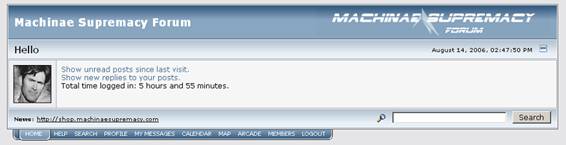
Usually the user-name of the end-user will appear next to the caption
‘hello’, as illustrated in Figure 2, beneath which, shows the avatar of the
end-user.
It is possible to change your
avatar as frequently as you like, however end-users on MaSu’s forum seldom do
this. This is unlike the practise with ‘signatures’, which are textual
excerpts that appear at the bottom of every post by the end-user. Some
end-users change their signatures frequently, either using images or caption.
When an end-user adopts an avatar however, this seems to be treated as if it
were as fixed as their user-name, even though it is easily changeable. Most
end-users I asked about this commented that it just did not occur to them to
change it. Some admitted they do change periodically, whereas others thought
it was ‘confusing’ when people changed their avatar.
Avatars themselves vary in
design from photographs of the end-users ‘offline’ self, self-rendered images,
pictures from TV/film, animated GIFs,
or anime images. Often, avatars are comic in style. The avatar image can
suggest interests of the end-user besides MaSu if they use a picture from a TV
show. My avatar was a picture from the TV show Brass Eye. One end user
private messaged (“PM’d”) me, congratulating me on being a fan of the show and
we sent each other multiple messages discussing our highlights from the show.
During the process of conducting this research, we never actually discussed
MaSu. It occurred to me here, that it was possible to be a member of the MaSu
online fan community and yet never talk about MaSu to some folk.
When I first came to the forum,
I was able to recognise some end-user’s posts, not by their user names, but by
the uniqueness of their avatar. Occasionally, avatars would be the subject of
discussion, with end-users wanting to know where another end-users design came
from. A particularly well-designed avatar is often given praise by other
members of the community. Avatars can be seen as part of a means of
establishing an online identity within a forum, which is not integral but
optional (some end-users opt not to have one). They are visual signifiers of
identity. As such, we can see that HCMC on forums is about more than just the
literally textual. I will talk more about the visual semantics of the forum in
a later section. In addition to avatars, end-users adopt symbolic user-names.
This is unlike the band, who use their offline first names, instead of
creating a symbolic ‘cyber-name’. Mine was ‘The_Holy_Ferret’.
Each end-user has a visible
status rating on the forum, and can be awarded ‘karma’ for positive
contributions to the community. These contributions can be file uploads such
as desktop wallpaper or a Winamp skin,
or simply comments thought to be exceptional within a discussion. Post counts
are also visible for each end-user. Administrators, moderators, and the band
themselves, have their own fixed status levels, although their post counts are
still visible. During the period 01/06/06 – 01/09/06, in which this research
was conducted, my status level remained at ‘newbie’, however I have since
achieved a post count in the hundreds and will soon progress onto the next
status level.
A frequent debate where online
communities are concerned is ‘how much does offline identity affect online
identity?’ Such a question is worthy of an entire Dissertation in itself,
however in the case of MaSu, it is clear that the band member’s offline
identities are highly important to the other users on the forum. Miller and
Slater, commenting on the theory of virtuality, in which the offline is seen
as not entirely independent from the online, note “that media can provide both
means of interaction and modes of representation that add up to ‘spaces or
‘places’ that participants can treat as if they were real” (Miller & Slater,
2000: 4). As such, even an offline name becomes a ‘symbolic’ name in for an
end-user’s ‘cyberself’.
It was evident that the steps
towards developing an online identity within the forum were not as applicable
to the band in the same way as they were to other end-users. For example,
their comments are welcomed more eagerly by the fanbase. Because different
rules apply to MaSu than other end-users, this implies the issue of hierarchy,
but also demonstrates the importance of the band to the forum, not merely as
textual providers but as individuals in their own right. This is not to say
there is not a fantasy element, or an element of adoration from the fans in
interacting with the band, but it does refute Hills’ arguments towards seeing
celebrities as texts in themselves. In his example, Madonna is more than just
a creator of musical texts, she is a text. This is in part due to the fact her
fans can never interact with her except from a consumer distance (Hills, 2002:
179). Such is not the case on the MaSu forum. One end-user PM’d me on this
issue, stating that:
The difference with MaSu is that they’re not up their ass like Metallica.
They’re not a bunch of guys who just make music. Because you can talk to them
and chill in the same virtual space as them, they’re people who you can
genuinely relate too. You can talk to them as a fan, but they can talk to you
back in the same lingo ya know? Like, we all have more in common than just
music. Computer games and other geeky stuff .
You don’t get that with Metallicrap.
It would be naive to suggest
that the only end-users important on the forum are the band. MaSu’s online fan
base spans across the world, with many fans unable to visit Sweden to see the
band play live. Prior to the release of the band’s new album Redeemer
(henceforth RDR), the band played some new songs live at various gigs
around Sweden. One new song called ‘Fury’ was bootlegged and a copy was
quickly available on the forum. Fans attempted to transcribe the songs lyrics
from the recording with limited accuracy, for purpose of analysis. I
contributed to the deciphering of the lyrics, debating certain words or
sections of the song which were unclear on the bootleg with other end-users.
When the album’s lyrics were finally made available, myself and the other fans
realised how inaccurate our transcription efforts had been, which then became
the subject of self-ridicule.
With ‘Fury’, the offline was
quickly assimilated into the online. Those fans with personal access to the
band offline, and who had heard the new songs, became figures of importance
because their access gave them greater knowledge than other members of the
forum. However, they only became important figures by virtue of them sharing
information. Discussions of live performances are common and even though the
forum has a specific sub-section for uploading pictures, videos, and comments
about the live shows, in the instance of ‘Fury’, the importance of hearing a
new song transgressed thread boundaries, as the fans desired to hear and find
out as much as they could about it.
The issue of ‘access’ is one
that MacDonald addresses, breaking down fan hierarchies into the following
categories:
·
Hierarchy of ‘fandom level’ or ‘quality’ – In this
instance fans are separated by amount of fan participation. Those that attend
fan conventions and the like emphasise a ‘quality distinction’.
·
Hierarchy of ‘access’ – Some fans have access to people
involved in the production of the ‘official’ item around which the fans social
discourse orientates.
·
Hierarchy of ‘leaders’ – In this instance, fandom is
broken down into smaller groups. Divisions may be geographically based,
interest, based, or based on further developed social relations (e.g.
Friendship). Within such groups, some people are delegated as leaders.
·
Hierarchy of ‘venue’ – Established when a fan hosts an
event/meeting of the fan community. This does not necessarily mean
geographically (MacDonald, 1998: 136 – 137).
Certainly a hierarchy of access
exists, but other concepts within MacDonald’s theory are problematised. The
‘venue’ is hosted by the band and to say there are ‘leaders’ is to grossly
misinterpret fan power relations. One of the benefits of an Internet forum is
that it allows people who may be easily dominated in the real world, to be
stronger in an online environment. The folk of the forum do not see themselves
as being led by anybody. ‘Fandom level’ however, is explicitly present by the
fact that post-counts are recorded and always visible.
Extensive vernacular knowledge
about MaSu demonstrates ‘subcultural capital’, in Sandvoss’ terms, which can
be related to the MacDonaldian ‘access’ category. For Sandvoss “[b]eing hip,
being in the know about clubs, records and fashion, become signifiers of
cultural status, and thus function as ‘subcultural capital’ (Sandvoss, 2005:
39). This concept opposes traditional notions of class-based systems of
capitalisation and is entirely subjective to the knowledge base of the fan.
Sandvoss’ concept of subjective
knowledge serving to designate hipness, within a social framework in which
hipness is valued over money, implies this knowledge can only serve the one
who beholds it. It is not used to help others identify what is ‘hip’, only to
be seen as being hip (Sandvoss, 2005: 39). This is not the case on the forum
though, as the sub-cultural capital held by certain fans of MaSu with ‘access’
or heightened knowledge levels are openly redistributed to the community as a
whole. It is a capital that is given away freely – an anti-capitalist
capitalism of vernacular exchange, a concept at the heart of what Tapscott
calls the ‘culture of interaction’ (Tapscott, 1999: 79). MaSu’s forum opposes
the Sandvosian position that sub-cultural capital serves only to maintain fan
power relations (Sandvoss, 2005: 40), rather it allows power relations to
exist, but they themselves are nomadic in nature. As Andrew Ross suggests, the
‘free for all’ information policy is one that originated within hacker culture
but has since spread into wider Internet culture. He notes, “[i]t is a
principled attempt, in other words, to challenge the tendency to use
technology to form information elites” (Ross, 2000: 256). MaSu’s forum then,
is characteristic of what Levy, in Collective Intelligence,
terms ‘knowledge culture’. Jenkins summarises the Levyian position:
Far from demanding conformity, the new knowledge culture is enlivened by
multiple ways of knowing. This collective exchange of knowledge cannot be
fully contained by previous sources of power - bureaucratic hierarchies (based
on static forms of writing), media monarchies (surfing the television and
media systems), and international economic networks (based on the telephone
and real-time technologies) – which depend on maintaining tight control over
the flow of information (Jenkins: n.d.).
Knowledge is not power, the
sharing of knowledge is power.
SHARED INTERESTS, SHARED
VERNACULAR, SHARED FANDOM?
Prior to the release of their
first commercial album Deus Ex Machinae (DXM), MaSu released
several ‘promo’ tracks as free downloads. Most of these songs featured lyrics,
however there were several instrumentals. Two instrumentals in particular,
‘Sidology Episode 1: Hybrid’ and ‘Sidology Episode 3: Apex Ultima’, became
objects of discussion more than the others. The ‘Sidologies’ are medleys of
computer game themes from the late 1980’s and early 1990’s, most of which are
well known within gaming culture and especially retro-gaming.Where MaSu’s other songs are largely influenced by computer game
soundtracks,
in this instance a relationship between MaSu and gaming is made explicit by
the band covering these well known themes. Discussions of these instrumentals
triggered talk about the games whose music was featured in the medleys. To
discuss the ‘Sidology’ tracks is to implicitly discuss gaming culture.
For a long time, MaSu’s
unofficial FAQ included the unanswered question “Where is Sidology Episode 2?”
The official explanation was that the song was not yet good enough to be
released. Fans on the forum almost anticipated this song almost as much as the
release of RDR, because its release completed a trilogy that had been
presumed abandoned. There were speculations, even requests, as to which
computer game excerpts would appear in the medley when finally released.
‘Sidology Episode 2: Trinity’ was finally released the day ‘www.hubnester.com’
opened. Hubnester is the name of the band’s front organisation, through which
they distribute all their merchandise. Upon the release of ‘Trinity’, a thread
appeared in the forum discussing which computer game themes were identifiable
in the medley. Robert eventually declared which themes were present, however
the fans were not satisfied with just this information. They then attempted to
identify where the individual game tunes featured in the ‘Trinity’ medley as
they had done with the previous ‘Sidology’ tracks. In ‘TRINITY OUT’, the track
was broken down into detailed sections as seen below/overleaf:
Supremacy
(0:00-3:59) (?)
R-Type
(4:00-5:50)
Skate or
Die (5:51-6:15)
<missing>
Zelda
(6:48-6:49)
<missing>
Last Ninja
2 (7:10-7:59)
Metroid
Prime (8:00-8:15)
International Karate (8:16-10:22)
Turrican
Loader (10:21-12:09)
Metroid
Prime (12:10-12:50)
The fans here demonstrate a
form of textual analysis, identifying which notes in ‘Trinity’ came from where
in computer gaming history. In order to participate in such a practise, a firm
knowledge of music from the ‘retro’ era of computer gaming history is
necessary. In order to appreciate ‘Trinity’ as a medley and not just an
instrumental, the end-user must be acquainted, either through having played or
having heard, the games whose music features in ‘Trinity’. Games like Last
Ninja 2, R-Type and Turrican Loader are all from the late
eighties and early nineties. In order to understand the significance of
‘Trinity’, it is necessary for an end-user to know these games. The
‘Sidologies’ explicitly reference the retro-gaming sector of wider popular
culture.
The band, being fans of gaming
themselves, had released a riddle with the release of ‘Trinity’ that their fan
base took to solving. The same vernacular knowledge of computer gaming was
required of the MaSu fans as the band themselves in order for this puzzle to
be accepted and completed. In this instance, MaSu too are fans of the
same discursive entities that their fan base also warms too. On the MaSu
forum, the homogenous interest in gaming from both the band and their fan base
means that between the two groups, a new object and, correspondingly, a new
level of fandom is created in which the producer and consumer are no longer
segregated. Just as fans can be fan/producers (to adopt a Hillsian dualism)
via the production of fan texts, we must acknowledge the existence of the
producer/fan too.
The band has admitted on
several occasions to being fans of anime and other types of animation. In the
thread ‘Film And TV Shows’, discussions of anime often show up among the fan
base, as well as other TV programmes and films. Because some of MaSu’s fans
are fans of anime too, we see compatible levels of fandom emerging between the
interests of both the fans and the band. When textual producers and their fans
share a fan appreciation for a work non-analogous to the producer’s creative
involvement, they can create a combined or joint fandom. This concept builds
on what Nancy Baym calls ‘joint projects’. As she notes:
In online communities, as in many offline communities, joint projects manifest
through the topic around which most discussions revolves. Despite its
centrality, topic is a woefully understudied influence on an online community
(Baym, 2000: 137).
Threads like ‘Film And TV
Shows’ allow for multiple fandoms to be occurring simultaneously, in which the
producer is not necessarily exempt from the social discourse of fandom. Within
this thread, it is entirely possible for MaSu to be participating in fan
discourse on their own forum. The creation of ‘Trinity’ makes explicit MaSu’s
fan status in relation to gaming.
Whilst band/fan hierarchies on
the forum do not suddenly ‘break’ because the object of discussion can switch
away from the band to gaming or anime, they can undergo a temporary process of
reformulation. Depending on what the object of fandom is, alters the social
discourses surrounding it in terms of band/fan relations. Fan studies have
well examined how fandom can be hierarchised vertically. In doing so though,
this ignores the horizontal reality that multiple fandoms can occur at the
same time, exemplified by the ‘Sidology’ medleys. Thinking along this
trajectory opens up a simple but overlooked question within Fan Studies, not
possible in the vertical model: ‘Would any band produce music if they were not
first fans of music themselves?’ The idea that you are no longer a fan
if you shift into a ‘producer’ discourse is poorly conceived and not one that
is evidenced on the MaSu forum. The advent of financial profit does not make
you less a fan.
With the distinction between
band and fan as totally segregate discourses now problematised, and having now
established that multiple fandoms can occur within an online social space
around multiple discursive objects, the question now raised is ‘what is there
on the forum that can be said to be culturally specific?’ This I shall detail
in the next section.
HYPER-REALITY AND THE EMIC/ETIC
DIVIDE
Nancy Baym, in ‘Tune In
Tomorrow’, notes the popular conception of “the social loser who can only make
friends online is in many ways quite similar to that of the soap opera viewer
who watches because the characters are easier to befriend than are neighbours”
(Baym, 2003: 241). But where a soap world is unreal, the Internet is
hyper-real, a simulacrum of the outside world encouraging end-user
interactivity with other (cyber) selves, unlike in the soap. As she further
notes; “[p]articipants’ interests and concerns oft reflect those that matter
to them offline” (Baym, 2003: 241). In the case of the MaSu online community
however, it is not the offline world that brought the folk together. MaSu’s
music was accessible initially only through the use of the Internet. It is a
case of the hyper-real filtering into the real, not the reverse. Which is the
‘dominant’ text, the live or the mp3, is an issue I asked the band for
clarification on:
[S]eeing a band live is an experience that can even change your view of music as a concept, and above all certainly your view of a certain band. I do believe however
that some fans are not the concert type and get the most out of the music while listening on mp3s on their computer.
Whilst one of the appeals of
Ethnography is its lack of reliance on a priori hypotheses (Hine, 2000:
42), a major methodological issue within any ethnographic approach is
identifying what elements of a culture are specific to it, and which elements
are culture-free, for which we do need some theoretical tools. William
Sturtevent, in ‘Studies In Ethnoscience’, divides cultural characteristics
into emic and etic categories. The emic qualities of a culture are those that
are specific to it, whereas the etic qualities are those which are culture
free, usually belonging to wider culture (Sturtevant, 1972: 133 – 135). From a
post-modern perspective, the idea that there can be anything ‘culture free’ is
extremely problematic, for even the language we use in day-to-day life
contains culture within it. Following the post-modern turn, in which concepts
such as the self, identity, culture and society have become fragmented, new
communication technologies further blur the line between the self and society
(Dodge & Kitchin, 2001: 21). For Christine Hine, the Internet is an “‘anything
goes world’, where people and machines, truth and fiction, self and other seem
to merge in a glorious blurring of boundaries” (Hine, 2000: 7). With this in
mind, how are we then to distinguish between what is etic and emic? Is an
end-user’s avatar an emic or etic cultural characteristic? If it is specific
to the MaSu forum, then it could be considered an emic quality, but if the
avatar contributes to the identity of the cyber-self outside just the forum,
it could also be considered an etic quality. Moreover, is it the avatar image
itself that is an etic quality, or the coding language that is used to make
the avatar appear? Coding language like HTML, XHMTL, JAVA script creates the
etic boundaries, because without such coding ‘virtual realities’ and their
corresponding communities cannot exist. Within the hyper-reality of the
Internet, the meaning of etic is in doubt, for it can be applied in many
different ways when the cues of offline reality are filtered out.
Similarly, with emic qualities,
we are posed with a similar problem. I hold no pretensions about solving the
etic/emic paradox where virtual ethnography is concerned. However, I propose
that on MaSu’s forum, we can see emic cultural characteristics designated
through certain HCMC discussions. For example, let us imagine a newbie asks
“what is Sid?” This is one of the most commonly asked questions about MaSu, so
much so that responses to it by other end-users are highly predictable:
- A recommendation to use the
‘search’ feature on the forum to see if such a question has been asked
before.
- The newbie will be
re-directed to the unofficial MaSu FAQ or MaSu’s Wikipedia entries.
- A genuine answer will be
provided, usually with the suggestion to consider options 1 and 2 in future.
I suggest that ‘the obvious
newbie question’ in-fact implies the location of certain emic types of
knowledge within the forum. Through identifying which topics occur the most,
and which issues occur most frequently in discussion, we might begin to be
able to understand what is culturally specific to MaSu and what is not. MaSu’s
unofficial FAQ, for example, answers many of the most commonly asked questions
about the band, which are all highly culturally specific but do not belong to
wider culture.
One thread, ‘The Newbies Guide
To Frequent Topics’, came about at the suggestion of various end-users that a
thread be created to stop similar topics being reposted again and again. The
topics covered here are often similar to those covered in the unofficial FAQ,
but here they relate exclusively to the vernacular of the forum. Within this
thread are links to several other sub-threads on common topics. When a topic
recurs so often as to warrant inclusion in either the unofficial FAQ, or a
thread such as ‘The Newbies Guide To Frequent Topics’, it is important within
the community because of its cultural specificity.
Two problems present themselves
within the ‘common topic signifying emic cultural characteristics’ theory:
- The volume of this
information is so extensive it would take a huge body of researchers a long
time to read it all and determine which are the most common topics. Hills
calls this overload of data ‘massification’ (Hills, 2002: 174).
- MaSu is not the sole
discursive object of their own forum, with computer games, TV shows and
other general topics also being discussed. Such topics relate to the offline
world outside MaSu’s forum. This poses the further question ‘can, and how,
does the offline world become emic online?’
The forum is designed to allow
end-users to discuss issues such as offline life, the band’s music, gaming,
and a host of other issues within certain thread boundaries, as I discussed
earlier. This implies that emic forms of knowledge are structured, at least
partially, by the layout of the forum itself. For example, discussing a game
like Half Life 2, which the end-user may play offline, is not an issue
directly to do with MaSu, but it can become an emic quality of the forum
community, when discussed within the boundaries of the ‘gaming’ section. The
issue of boundaries therefore suggests that there are in fact multiple levels
of emic and etic, but not a clear divisible single line between them. The
end-users of the forum know what discussions belong where within their world
and I quickly became accustomed to these discursive boundaries.
Within ‘The Newbies Guide To
Frequent Topics’, is an HTML link to the MaSu ‘Crap Pack’.
The ‘crap pack’ is a webpage full of music that is not part of the bands
official discography. This page contains many mp3s of MaSu tracks in the
instrumental phase of their production, or tracks which have since been
replaced by remastered versions. Whilst these tracks are not ‘official’, they
are allowed to circulate within the MaSu online community by the band. The
presence of these rare tracks facilitates the needs of the MaSu fan base to be
completists, an ideology which was not intended by the band, but not
discouraged either:
The fans have in their own might created that need-to-have, and the forum community, I believe, is where that message is spread and absorbed. There's even a thread
at the forum about how many "machinae supremacy files" you have!
The bands unofficial FAQ and
Wikipedia pages list all the tracks which have been replaced by newer
versions. This information, and the tracks themselves, are shared freely among
the MaSu community.
Within the forum, it is not
uncommon to see threads containing links to other threads, directing end-users
to the appropriate location to find information discussed and/or made
available before. The unofficial FAQ also contains links to forum discussions.
This referencing of information sources within the community is used to
demonstrate the credibility of the data, similar to the academic practise of
citation. In addition, the Wikipedia page ‘List of Machinae Supremacy Promo
songs’ also cites the forum as a source of information.
In the case of Wikipedia, virtually anybody can edit the information
maintained on the site, making it impossible to trace who added or subtracted
what information. I did discover however, that the band did not create any
entries, as this interview excerpt demonstrates:
We haven't entered anything into either of those, but I'm sure we've answered questions by fans who did. I love that there's so much info on us at Wikipedia, and the FAQ is nice too.
It is discernable, through the
continual use of links to other sites of knowledge, that information is
directly exchanged between the FAQ, forum, and Wikipedia. In the relationship
between the three, the forum can be seen as the nexus of information. The
unofficial FAQ and Wikipedia pages can be seen as ‘starting points’ for the
uninitiated, those end-users eager to become fans but without the social
relations yet established to gain the level of knowledge of their peers. Some
folk on the forum explained to me that for them, information in the unofficial
FAQ and Wikipedia entries is established as that which no fan has an excuse
not to know. They are sites where vernacular knowledge is made ‘semi-official’
through their fixed status. I do not mean ‘fixed’ as to imply that the data is
static, as new information is always becoming available and being added,
however the location of these knowledge bases is as fixed as is possible
(short of server malfunctions, data erasure etc.). This provides end-users
with knowledge of the band from directly within the fan community, not
contorted by mainstream press coverage or media institutions like ‘Kerrang!’
or ‘MTV’ that selectively report information about mainstream rock/metal music
to a mass audience.
Until a methodology is devised
to determine how we clearly distinguish between the emic and etic qualities of
virtuality in virtual ethnography, I do not feel capable, nor do I feel it my
right, to impose such categories on the community. I do recognise the
importance of the emic/etic dimension within ethnography though, and the
location of vernacular information nexus’ is contextually useful when
considering the formulation of vernacular theories on the forum (which I
detail further in a later section). Having now established the relationship
between different types of information on the forum, where culturally specific
information is obtained and how the folk identify it, the next section
discusses the meaning-making processes the folk practise in order to make this
information useful.
NEGOTIATED MEANINGS ON THE
FORUM
John Fiske has been
particularly influential in the conceptualisation of consumers as negotiators
of meanings in texts, which has had particular ramifications for Fan Studies.
The issue of meaning on websites, and not just forums, is a difficult one
though. Where film is a complex semantic entity because of its combined use of
visuals and sound, meaning is presumed to be negotiated primarily within the
narrative of the text. On a website, the narratological structure of HCMC is
just one factor, to which we also have to consider the imagery on a website,
the HTML coding, standard text, use of video, sound, and other practicalities
of the medium.
With the consumers being in
such close contact to the producers, it would be quite possible for MaSu to
impose the ‘correct’ meanings of their songs on their fan-base. In Textual
Poachers, Jenkins gives the example of a group of Star Wars fans
who wrote fan fiction of ‘feminist-inflicted erotica’ nature. This was in
rejection of what they saw as Lucasfilms’ insistence that they view Star
Wars sexuality as corresponding to heterosexual male normative values
(Jenkins, 1992: 31). Whilst there have been no particular discussions of
feminist-erotica in relation to MaSu’s songs, threads have appeared in the
forum designed to specifically discuss songs meanings. Unlike in Jenkins’
example though, these are generally free from intervention by the textual
producers. The idea of oppositional readings seems inappropriate when the band
is actively allowing the social space in which multiple meaning(s) of their
songs are created. Opposition implies MaSu do not want this, which is not the
case.
After the release of RDR,
a thread appeared specifically to discuss the meanings of the new songs. Fans
debated meanings with each other, developing ideas based upon each others
posts, but also agreeing to disagree on many issues. Here, the issue of thread
topic again evidences Baym’s ‘joint project’, a cybertext in itself, in which
end-users combine their vernacular theoretical resources with the purpose of
understanding the lyrical messages of MaSu. The ambiguity of MaSu’s lyrics,
and the absence of any ‘imposed’ meanings by the band, means the semantic
process here is less a case of ‘reading against the grain’, and more a case of
‘celebrating the grains semantic diversity’. As one end-user comments:
Surely the meaning of the song isn’t something worth getting stressed over? If
MaSu wanted us to know exactly what the songs were, they would say or make
them simpler in the first place. Being able to read into them what you want is
what makes them enjoyable to each of us in our own different ways don’t you
think? We should enjoy the bands diversity, not bitch over what may or may not
be there. It’s just good that it CAN be there.
The songs with more seemingly
obvious meanings notably triggered less discussion than those songs where
meanings were unclear. One notable exception occurred to this rule with the
song ‘Legion Of Stoopid’. In ‘Music + Politics = ?’, the lyrics of this
particular song were highlighted specifically by one end-user who found the
‘obvious’ meaning of this song to be disagreeable. This particular end-user
questioned why a Swedish band would write a song like ‘Fury’, which is
concerned with American news media. In this instance, Robert replied to the
post, commenting that although he usually keeps quiet on political issues on
the forum, this was one worthy of attention.
What followed was a debate that included discussion on American foreign
policy, the Bush administration, and the nature of the war in Iraq. In this
case, the ‘intended’ or ‘hegemony’ reading of the text was revealed when
Robert confirmed that this particular fan had read the text, and perceived its
meaning, correctly. The HCMC that followed was not due to oppositional or mis-readings
of the text, as both producer and consumer were in semantic agreement, however
they were not necessarily in agreement with what the song was saying. Within
the active audience tradition, we are now accustomed to the idea that if
audiences do not like a meaning, they will try and interpret a text in a
different way. Here, meaning was certainly an issue of contention, but not
because of semantics, because of differing politics. It is sometimes worth
remembering that not all disagreements about meaning are the result of
oppositional readings. For Tulloch:
To say that fans promote their own meanings over those of producers is not to
suggest that the meanings fans produce are always oppositional ones or that
those meanings are made in isolation from other social factors (Tulloch, 2004:
296).
Tulloch’s position can be
pushed further by seeing that opposition can also occur when the semantics are
agreed upon. This infers that fans do not always promote their own meanings
over the producers, they are quite willing to accept the ‘correct’
interpretation, but they do not necessarily have to like it. The discussion
about ‘Legion Of Stoopid’ was the only major instance I identified where
in-depth discussion of a songs meaning took place between both producer and
consumer.
The issue of semantics appears
in more superficial discussions as well. The song ‘Kaori Stomp’ features
lyrics in Japanese and fans who could not speak the language were frustrated
at not being able to know what the lyrics meant. Eventually, Robert uploaded a
translation of the lyrics, but not before one particular fan went to the
trouble of translating them himself. When the lyrics were translated, the song
did not go on to become a particular object of discussion within the thread.
What we see here is that the meaning of this song was not as important as the
potentiality to uncover its meaning. By not having access to a translation,
the fans missed potential insight into the workings of the band, which is not
permissible.
Thus far I have treated meaning
as an issue pertaining to HCMC of a literally textual nature. Earlier on I
commented on avatars, how they could be seen as ‘markers’ of identity, and I
pointed out the frequency of anime art in some end-users avatars.
Unfortunately, I do not have access to all the images used by the band during
online publicity since their inception. Some of them have resurfaced in the
forum or elsewhere at various points in time. Where most bands feature a
biography with pictures and descriptions of the individual band members,
MaSu’s official website in an early incarnation did so with a slightly unusual
twist – no photographs were given of the band, only anime-style images. The
recurring presence of anime imagery in the forum from the fans in addition to
this, gives the wider culture surrounding MaSu a particular visual aesthetic
in itself.
Whilst, my skills are not in
the textual analysis of website design, the anime factor is interesting
because it signifies a commonality of interests between producer and consumer
other than rock music or gaming. Building on my earlier concept of joint
fandoms, meaning can be seen to be contained within the visual here, by
signalling interest in an artistic form/sub-culture outside of the forum. This
is also true of gaming references. I asked MaSu if they thought the gaming
influences in their music were important in the bands reception:
Maybe in a broader spectrum, like saying for instance that metal is easier to market online than folk music, due to its listener base's familiarity with computers and the
Internet. It does influence how we want to profile ourselves, however, I mean a fantasy theme on an album cover for instance would not fit well with our technocentric
metal identity.
Joint-fandom can be seen as
instrumental in the bands self-profiling when both band and fan have a shared
meaningful understanding of the significance of computer game or anime
aesthetics.
I have demonstrated thus far
how the band is not the sole discursive object of discussion within the MaSu
fan community and how MaSu’s fans negotiate meanings on the forum within the
band’s texts, but do not necessarily oppose them in the Fiskian sense. The
next section concerns more explicit negotiations between producer and
consumer.
THE MULTIPLE DISCOURSES OF
BAND/FAN DISCUSSION
Van Maanen in Tales Of The
Field, reflecting on the work of Clifford Geertz, suggests an ethnographic
account of a culture’s human participants can be achieved by examining the
relationship between what they say and what they do (Van Maanen, 1988: 17).
Within online forums this is problematic, as all interaction is multi-textual
for when an end-user types text, it also creates HTML code text, invisible to
the GUI.
In most circumstance, what end-users ‘do’ is revealed directly through what
they ‘say’ via HCMC. Dodge and Kitchin, building on the concepts of Rheingold,
suggests that cyberspace is a place defined by words rather than body (Dodge &
Kitchin, 2001: 53). To ‘do’ implies a physical, or at least extra-textual,
action. Online, the ‘saying’ and ‘doing’ of cyber-culture are blurred
together. For David Bell, Cyberspace is an all encompassing environment, in
which ‘what it is’ and ‘what it means’ are inseparable (Bell, 2001: 7).
However, that is not to suggest that by looking at HCMC, we cannot see
different strategies of cultural participation, suggestive of the ‘doing’ of
culture. This section draws attention to a number of social discourses, ‘done’
by cultural participants, that I observed.
MaSu’s fans are often critical
and aware of their own status as fans. As one user comments:
[…] it isn't wrong to admit that you don't like something, even with such a
good band as Machinae. Praising anything they do won't do any good; let them
know when you don't like something, give constructive suggestions how it could
be done better and maybe they'll get some other ideas for the next song. You
don't have to be a fanboy/girl, just be a fan.
The
‘fanboy/girl’ is a blind follower of MaSu, who will not hear a wrong word said
of the band. For this particular end-user, such an attitude is unconstructive.
The quote expressed recommends that ‘real fans’ adopt what academics might
call critical distance. Certainly the online MaSu fanbase are not un-critical
of the band’s works, voicing their displeasure about certain songs, and even
issues such as CD packaging:
[…] also the quote on the inside this time round. Buffy the vampire slayer?
Thats not too epic for me, but on DXM they found Kierkegaard.
This particular end-user felt
that RDR was insufficiently ‘epic’ in feel compared to DXM,
reflected in the fact that where DXM quoted Kierkegaard in the CD
booklet, RDR quoted Buffy The Vampire Slayer. Upon reflection, I
wish I had defended Buffy.
Certain end-users were more
articulate in their criticisms than others, some talking purely in terms of
aural aesthetics, some about lyrics, some were much more technical about the
music. As one fan comments on the audio mastering of RDR:
It clips. Why do you participate in the loudness race? It's no use. If someone
want's to hear the music loud, he will simply adjuste the volume knob on his
stereo. Increasing the level on the CD until the edge will just degrade
fidelity and introduce clipping. The lost data can never be restored. Also,
excessive dynamic compression makes the music dull and long listening gets
fatiguing. That's not a MaSu problem. The vast majority of today's releases
are mastered too hot, but it's always a pity when a CD that you love is
affected.
Peaks all chopped off:
Redeemer (top square wave), other recently released CD with sensible volume
(middle), random music DVD with usual volume (bottom)
In this instance, the fan’s
criticisms are technical, akin to a film fan commenting on a director’s choice
of lens to shoot a particular scene. This end-user uses screenshots taken from
a sound-editing programme, as he indicates in the quote, to demonstrate where
the ‘faults’ lie in RDR’s mastering. This is an action ‘done’, but
still represented through the textual. The ‘doing’ of a culture in cyberspace
is a symbolic activity, reliant on expression through the ‘saying’ of HCMC.
Robert replied to this post,
justifying his preference for heavy mastering, in comparison to the “lame”
mastering of DXM,
responding in similarly technical terms. Whilst my knowledge of mastering was
not sufficient for me to partake in the discussion, it was evident here that
the band and their fans were able to talk using the same musically technical
language and music related theory. This ‘insider theory’, in McLaughlin’s
terms, is also ‘outsider theory’ to those on the forum, besides the band, who
know about audio mastering.
Some fans identified that
tracks from RDR had been used partly before in the Jets ‘N’ Guns
(JNG) computer game soundtrack and were displeased that excerpts from
free songs were being ‘reused’ in the commercial album. This led Robert to
comment in reply:
It may have escaped most people that Jets'n'Guns was not made for you. It was
made for Rake in Grass, and the game Jets'n'Guns. We chose to release it for
free (becuz we lub j00 guyzzes) because we could. So I get a little sad when
this hits us in the face like it's a bad thing. We sometimes back-reference
lyrics, and there's no denying that regardless of what came first, parts of
songs has been reused. But I think anything that you hear on Redeemer is quite
different from it's "counterpart" on JnG. Those who'd claim that Reanimator is
the same as FutureMachine, I'd like to urge to reconsider.
Some days
after this post, Robert created a thread announcing that the bands third album
would feature a re-interpretation of the track ‘Flight Of The Toyota’ from
JNG.
This was directly because of the earlier discussion and evidences that the
band is not in a position to ‘abuse’ their status as textual producer. If the
fan base thinks they are being ‘cheated’, they will voice opinion. Here, the
‘done’ is implied through HCMC, by virtue of the fact that extensive listening
to RDR must have been conducted in order to make these critical
observations. Listening to RDR does not require an Internet connection,
so cultural practices can occur outside the boundaries of the forum.
Effectively though, they only become ‘done’ in virtuality when they are ‘said’
through HCMC. As such, what is ‘done’ is irrelevant except through end-user
disclosure. As Kanayama suggests, “most
behaviours and actions in the virtual community are inscribed only as visible
discourses” (Kanayama, 2003: 273).
As demonstrated in the examples
given in this section, MaSu fandom is not a case of wish fulfilment by
engaging with a ‘virtual celebrity’, but a dialogue between the textual
producer and consumer that requires constant two-way interaction. Fans are not
talked down to, and can discuss issues about the technicalities of production
with the band on an equal level, whilst still being self-reflexive about their
social position as fans. They are aware of their multiple possible fan
identities such as ‘fanboy/fangirl’ or ‘critic’.
Having now addressed the
complexity of issues of identity and hierarchy, multiple levels of fandom,
culturally specific knowledge, and negotiations of meaning between both fans
themselves and fans and the band combined, I am now in an able position to
discuss how and where genre discourse operates within the forum and what it
means to the folk there.
GENRE, WHAT GENRE?
A previous incarnation of
MaSu’s homepage featured the quote “The origin of Sid Metal” as the title of
the HTML. Within the unofficial FAQ, the lexemes ‘New Frontier’ and
‘Alternative Rock’ have been used as labels for the band’s musical style.
Wikipedia, as well as various webzines, also refer to the band by the term
‘Sid Metal’. All of these labels belong within vernacular discourse, as proved
by the fact they appear on the likes of Wikipedia and the unofficial FAQ.
These labels have emerged from within the MaSu online community, rather than
being imposed by some external body. In an interview on the metal webzine
‘Treehouse Of Death’, entitled ‘The Commodore Generation’, we gain a more
specific insight into the band’s ideas about what genre they operate within:
I believe the main thing, if you were to ask the average fan, is the use of
video gaming influences and sounds in combination with serious shredding
metal… Though we’re never afraid to sweeten it down a bit now and then,
either. The vocal style is also not one commonly heard in metal bands.
The band
here describes their musical style as if from the perspective of a fan. Their
close interaction with their fan base gives them the opportunity to do this,
rather than just talking about the music in technical terms. The complete
interview also reveals some of the bands musical influences, both computer
game related and from the rock/metal spectrum. In the latter case, the bands
cited as influences are from a wide variety of genres such as thrash metal,
Swedish punk, even Kiss get a mention. Interestingly, MaSu’s fanbase, in their
discussions of their non-MaSu musical preferences reveal a wide spectrum of
bands from different genres. There were those who liked metal, those who liked
punk, electronica, classic rock, pop, and in most cases they liked a
combination of different styles. This eclecticism makes it virtually
impossible to group the MaSu fanbase into any one musical sub-culture such as
Goth, Emo, Indie, Punk, or Metalhead (Muggleton, 2000: 12).
One of the
most celebrated aesthetics of MaSu is their use of the Sid-station and
synthesiser. The ‘Sid-station’ is a hardware application used to generate
sounds that can be loaded into a synthesiser. The sound chip within it is
taken from the Commodore 64 home computer, which was very popular during the
late 1980s. Because of this, the sound it creates is one that originated in,
and is usually associated with, computer gaming. ‘Sid-metal’ designates a
sub-genre of heavy metal that incorporates the use of the Sid-station to a
large extent.
For the band, the Sid-station is just one of many elements to MaSu’s music, as
Gordon explained to me in a thread I initiated to find out just how important
the use of Sid was to the community:
Machinae is not only sid stuff. Machinae is good
music.
 Sometimes
we don't use sid and have other synth sounds instead. But we like sid a lot.
Sometimes
we don't use sid and have other synth sounds instead. But we like sid a lot.
For some end users the Sid was a pivotal ingredient
in their sound, as this particular end-user comments:
Well, MaSu is a great band, even without the SID.
But: I came to like Machinae because of the retro-gaming-like SID-sounds and
their songs that remind me of old video games like Hero, Arcade and Player
One. Of course I like the other songs, too, because I like their style and the
themes of most of their songs. But what made me a fan of their music, and what
makes them unique to me, is their videogames style and the SID sound. I think
they'd just be "that band I heard last week" without video games and without
the SID. SID makes them Machinae Supremacy.
For others, MaSu is an issue of more than just the
Sid aesthetic. As one end user suggested:
‘Listen to chuck rock in the crappack... it sounds
extremely videogamey, but doesnt use any sid!
This end-user introduces the idea of MaSu as
‘videogamey’ in sound, but not directly because of the use of Sid-station or
synthesisers. Since it appeared that the issue of Sid was not as pivotal as I
had anticipated, I asked how important being a gamer was in the liking of MaSu
and was there anyone on the forum who actively despised gaming, to which I
received this reply:
on here, not that i know of. but ive introduced
machinae to a lot of mates who had no previous interest in gaming, and they
absolutely loved them. none of them really seemed to "get" the sidologies, but
they loved most of the songs, and liked the sid sound because of it's
uniqueness.
Another
end-user reinforced this opinion stating that “id
say its just more likely gamers will enjoy MaSu then non-gamers, not that
non-gamers are likely to dislike MaSu.”
The issue of Sid-station necessity is not one that can be generalised over,
however, we can generalise that by being a gamer you hear more in MaSu than a
non-gamer (the significance of the ‘Sidologies’ for example). For some, the
gaming connection was personal:
I love the SiD. Its the number one sound from my
childhood, and Machinae represents that innocent, I-can-do-anything feeling
that I had as a child, not only via the SiD but in the lyrics as well. I
haven't heard Redeemer yet (roll-on payday!) so I can't comment on any SiD or
lack of there, but I do know my fave Machinae tracks are the SiD-heavy ones,
like the Jets'n'Guns soundtrack.
In this
particular thread I created, only one end-user mentioned the significance of
the Sid-station as qualifying the band as ‘Sid metal’. Having outlined in part
one the importance of considering the vernacular of both the producer and
consumer, I needed to know where the band ‘stood’ on the genre issue. This
interview excerpt reveals a great deal on this matter, specifically concerning
the issue of being tagged by one genre label:
I don’t believe it really matters from an audience/fan point o view, though.
I’ve noticed how Machinae Supremacy fans seem to give the band the genre label
that best fits the songs they like the most, and I think that’s ok. It doesn’t
really hurt the band, or any band for that matter. The disadvantage with “Sid
Metal”, even though we coined the phrase ourselves, is that it has no meaning
to anyone who doesn’t know what “Sid” is. Many people recongnize the video
game influences, but that doesn’t mean they know what the sound chip was
called.
As the
band sums up; “it is clear to me and many people I’ve talked to, that even
though you can’t put a simply, standardized label on our music, you can still
always tell it is us.”
This attitude was reflected in many discussions on the forum. MaSu are
sometimes loosely categorised as metal or rock, but the issue of genre largely
surfaces only in two situations:
- When
discussions of introducing the band to the ‘uninitiated’ is concerned.
- When it
is necessary to compare MaSu to an etic outside criterion.
Fans were
able to formulate expectations of what aesthetics ‘makes’ MaSu sound like MaSu,
and in some instances, referencing other genres of music was a means to do so,
as in the below example:
Machinae is true metal. Not metalcore. Any metalhead will be able to tell you
that going metalcore is a bad move for a band these days. Especially if
they've already got a true metal sound to them. Going metalcore would be
throwing it away, really.
This fan
in particular defines MaSu as a metal band, but what genre of metal is
unclear. ‘True’ implies ‘purity’ to MaSu, which this end user does not feel is
present in the ‘metalcore’ genre.
Within wider metal culture, the term ‘true’ is used in opposition to ‘fake’ or
‘poser’, generally associated with ‘mainstream’ bands. Its appropriation here
was used to defend MaSu against accusations that they might pursue a more
commercial ‘screamy’ direction.
Before the
release of RDR, three songs were made available from the album
sessions. One of these, the fans were initially informed, was not going to be
on the album, but following fan praise, it has since ended up as a bonus track
on the ‘Retail Edition’ of RDR. Whilst many fans praised the songs,
some users felt there was an absence of the use of the Sid-station in
comparison with MaSu’s previous efforts. This has proved to be a recurring
observation regarding RDR in general. A poll was set up to vote and
discuss which album out of DXM and RDR was the best. Some fans
preferred DXM, usually citing its greater use of the Sid-station and
more consistent atmosphere as being a crucial reason, others preferred the
‘rawness’ of RDR and its more varied atmosphere. There were several
other reasons for these positions too and I do not wish to imply the opinions
of the MaSu fanbase could always be segregated into simple camps. MaSu’s fans
are not unable to account for their warming to the band, as the likes of Hills
would suggest, they have discernable reasons why they like the band and why
they like certain songs/albums more than others, but these cannot be reduced
to mass generalisation. In threads such as the ‘DXM versus RDR’ thread, we can
see that some fans had formulated vernacular theories of how much Sid-station
was necessary or expected from MaSu. These views were not homogenous though.
Some end-users commented that since MaSu had developed their sound from the
beginning, it was expected that RDR would be different. Two theoretical
vernacular frameworks are present where the issue of the Sid-station is
concerned:
- A
framework in which MaSu have an expected level of usage of the Sid-station
and a ‘concrete’ standard of aesthetics which should be adhered too.
- A
framework advocating musical evolution, which can include more or less use
of the Sid-station where appropriate.
The song
‘Hate’, off RDR, is arguably one of the ‘heavier’ songs in the band’s
catalogue. Some end-users suggested the band use a ‘scream’ vocal style
occasionally, stating that it may compliment a song like ‘Hate’. As one
end-user commented, “[h]ostiles just cannot be sung, it's not possible.”
Some end-users welcomed the concept of scream vocals, other responses were of
the ‘ARE YOU MAD?’ variety. For many fans, the lack of screaming was not only
something that appealed to their tastes of vocal style, but it was also a key
ingredient in what makes the band different from other bands:
I think that's the stylistic device of the song. Everybody can make a song
called "Hate" and growl his/her lungs out...
Here, fans
theorised specifically about MaSu’s vocal style – its appeal, its benefits,
and why it should/should not remain the way it is. Musical aesthetics can be
broken down into singular components, if discussion warrants this. To be able
to discuss MaSu’s aural aesthetics with other end-users on the forum, an open
mind is compulsory. Statements about MaSu’s sound that are claimed as if they
are objective fact are usually critiqued by other end-users.
Within the
comments on these threads, one can clearly see end-users developing their own
rules and ideas of what MaSu should/does sound like and what aesthetic
attributes are entailed. Where scholars may recognise discussions of musical
conventions as, at least implicitly, suggesting a genre discourse, the term
‘genre’ rarely appears on the forum. Those fans that missed the overt presence
of the Sid-station on RDR made their comments in reflection of MaSu’s
other works, not in terms of a generic expectation. Whatever work by the band
that is being discussed is always compared to the bands other works first,
before bringing in outside criterion.
Notably,
the band members largely did not interfere in such discussions, rather fans
were left to discuss their ideas of what makes MaSu who they are. The fans are
given a social space in which they are actively encouraged to theorise about
MaSu’s style, even if it opposes the views of the band. The expected “do’s and
‘don’ts” of the bands style, from the perspective of the MaSu fan base, is an
issue the band are aware of. I asked them to clarify the issue for me, also
questioning what is gained for them by maintaining such close contact with
their online fan base:
Some of the do's and don'ts we've "planted" and others they came up with all on their own. We try to remove what we feel are misconceptions if we find any, but mostly
we let the fans maintain their view of what is what. I think we achieve, first and foremost, a direct feedback link that is very valuable but also sometimes frustrating and
annoying. But when the feedback is positive, it really juices us up to go on and keep producing and playing because we get to see the result and effect our work has,
instantly and up close, on our audience.
The genre
status of MaSu is largely an irrelevant concept within the community. One of
the most commonly celebrated aspects about the band on the forum is how they
are so dissimilar to other bands in terms of their sound. It is arguable then,
that genre does not emerge as a discourse in specific relation to MaSu’s
aesthetics on the forum because MaSu are not part of a ‘movement’. There are
no other bands playing the particular style that MaSu play, thus ‘Sid metal’
exists as a lexeme, but not a generic discourse in itself. Genre is a concept
applied to a group of entities, serving to prompt aesthetic comparison. On the
forum, MaSu are celebrated because of their lack of comparability. To the
fans, MaSu are not ‘Sid metal’, ‘new frontier’, ‘alternative rock’ or any
other genre. They are simply MaSu.
A genre
cannot be said to be an independent object arising from a sole text. A band
can defy all pre-existing generic classifications, but do not represent a new
genre
themselves
until they are part of a wider corpus of bands demonstrating analogous
aesthetics. New generic conventions do not designate new genres alone. This
seems to imply that genre is an issue of quantity, not quality. From an
industry point of view, MaSu do not fit an existing aesthetic mould and thus
are not part of a mass-marketable generic movement. From the fans point of
view, they are not part of a mass-marketable generic movement because they are
not fashioned from an existing mould. Whilst in the case of the former they
may be dismissed, in the case of the latter, they are celebrated. For the folk
of the forum, genre is an insignificant concept compared to the wider
phenomenon of MaSu as a whole.
Part Three
Conclusions
‘THROUGH THE LOOKING GLASS’: THE BENEFITS OF DIRECT
CONTACT WITH THE TEXTUAL PRODUCERS
During the course of writing
this Dissertation I sent several questions to the band in an e-mail, some of
which raised the issue of online marketing. This was widely dismissed by the
band, who commented their only form of marketing had been through their fans
telling other people about them. From my scholarly perspective, I had thought
that the release of tracks like ‘Ghost (Beneath The Surface)’ were part of
some grand design, released at a specific date for a specific reason. For a
scholar, the concept of a text being released ‘whenever’ is not viable. It
has to fit a model, there has to be a meaning, and nothing occurs
ad hoc. Thus, when I asked the band why they redesigned their website
and released ‘Ghost (Beneath The Surface)’ when they did, I was shocked to get
this reply:
Our old website was great, but we felt that it'd been around for nearly four years and it was time to make a change. It's not about dissing the old one but rather upgrading the look a little to breathe new life into the online face of our band. I'm not sure if there was any conscious thought to when we made Ghost available, though. :)
I had over-analysed the
significance of the redesigned MaSu website and the release of ‘Ghost (Beneath
The Surface)’. The reality was that these events occurred, not as part of some
grand marketing strategy, but because the band just felt ‘it was time to make
a change’. Harold Schechter in The Bosom Serpent, notes the way
scholars over-intellectualise fictional narratives in popular culture, because
of the academic necessity to raise them to a level that can warrant analysis
within the academy (Schechter, 1988: 4 – 5). Such criticisms were applicable
here too. Through contact with the textual producer, and of course the fans, I
was able to identify when I had over-read elements of MaSu and the forum
culture.
MaSu is a worldwide phenomenon.
Though their fanbase is nowhere near as big as the likes of Iron Maiden,
through their website MaSu form closer relationships with their fanbase:
I believe that on top of the website it has been our close connection and willingness to intermingle with our fans online that's made them so motivated to spread the word and our music. Machinae Supremacy has gained its fame 100% thanks to the fans, since no advertising or similar has ever been done by us or anyone else. We simply made the music and made it available, as well as maintain
the site, the forum and such, and the rest has happened on its own.
As Dhalgren notes, “the old
model that equated mass availability with mammoth corporations such as the
BBC, is out-dated in the era of media convergence, because the bourgeois ‘high
culture’ have no hegemonic control of the medium that reaches the masses”
(Dahlgren, 1998: 301). The issue of hegemony struggle seems inapplicable when
thousands of people can now obtain over the Internet what someone produces in
their bedroom, through the likes of video-sharing communities like ‘You Tube’.
Scholars of the hegemony conflict school are looking for struggle where there
is not any because of age-old distrusts of anything associated with the term
‘mass’, but as MaSu explained to me: “[W]e never thought we'd be this famous
when we started, so there were no thoughts of "industry logic" as you put it,
or any other plans for world conquest.”
For Hine, “[t]he audience is an
imagined category that producers orient to in making their work meaningful” (Hine,
2000: 37). In addition, “[c]ategories such as producer, user and audience are
constructed through the practices of production and consumption” (Hine, 2000:
37). We have come to think of these terms as mutually exclusive, predominantly
because of the general inaccessibility of the producer to scholars. I have
demonstrated how producers are as much fans themselves as the folk who
celebrate their works. With the benefit of insider knowledge from the band, I
have avoided the typical Reception Studies pitfalls of implying the
prerogatives and desires of textual producers without any verification.
‘INSIDIOUS’: PROBLEMS
ENCOUNTERED DURING THIS INVESTIGATION
In Part 2 I discussed Van
Maanen’s idea that ethnography is about reporting the relationship between
what is said and what is done in a culture. I noted that this was problematic,
because the online world is textual on several levels. I am aware I have
ignored issues such as hypertext in this research, in this instance not
referring to the post-modern conception of ‘hyper’, but that of hypertext
markup language (HTML). Certainly a more technical approach to analysing
forums is welcomed by myself and other scholars within the field such as David
Bell, but for now the ‘doing’ of cyberia remains textual (Escobar, 2000: 62 –
66). Exception occurs in the instance of offline interactions that impede on
the online world, like sitting at one’s computer (Bell, 2001: 195). Online
ethnography cannot reveal such details however, for as Hine suggests:
The ethnography
of the Internet does not necessarily involve physical travel. Visiting the
Internet focuses on experiential rather than physical displacement (Hine,
2000: 46).
This is one of the many ways in
which virtual-ethnography differs from orally based ethnographic traditions
emphasising body-to-body communication, absent of any cyber-mediations. The
complex relationship between the ‘done’ and the ‘said’ was not one I had
sufficiently accounted for. Where the likes of Van Maanen, in Tales From
The Field, could report the actions of people in the culture para-textually,
any such physical/body to body interactions were lost to me. Hine notes that:
Traditionally,
oral interactions have been foremost for ethnographers, and texts have taken a
somewhat secondary role as cultural products, worthy of study only as far as
they reveal something about the oral settings in which culture resides.
Hammersley and Atkinson interpret this reliance on oral interaction as part of
the ‘romantic legacy’ of ethnography (Hine, 2000: 52).
In my research I had no choice
but to treat my data as entirely textual, dispensing with any such
romanticism. As such, I found myself straying into discourse analysis on
frequent occasions, rather than documenting my social interactions and
formulating what I had initially assumed would be a ‘confessional tale’, in
the truest Van Maanian definition (Van Maanen, 1988: 73 – 81). As Howard
notes, one of the problems with ‘virtual ethnography’ is that
“[m]ethodological innovation had not kept pace, sometimes resulting in studies
that claim to be ethnographies but that are clearly not the product of an
authors’ immersion in the lives of their subjects” (Howard, 2002: 551).
Essentially, the experiential interactivity dimension becomes lost in
translation.
Through the re-drafting process
I incorporated more classic ethnographic descriptions of interactions between
myself and the MaSu community, both fans and the band. The likes of Miller and
Slater’s The Internet: An Ethnographic Approach, whose work was of
influence to me, made no mention of such quandaries and neither did other
works of virtual ethnography I encountered prior to setting about my
methodology. Having never practised this kind of ethnography before, I have
since become aware of how easy it is to represent forums in a manner that
‘laboratises’ them in the write up.
I had underestimated the
methodological quandaries I would encounter. In addition, I also felt slightly
overwhelmed at the amount of theoretical work on cyber-culture and
cyber-studies in general. Having had only a limited exposure to this during
the course of my MA, I had a lot more ‘new information’ to take in than I had
anticipated, for I had naively presumed the bulk of my research would be
mainly around ethnography. However, cyber-centric investigations require a far
greater knowledge of the politics and technicalities of the medium than I had
encountered previously in my academic career. As I am reasonably computer
literate I was able to overcome the latter, but upon reading the vast amounts
of scholarship on cyber-studies I became aware of a great many issues and
implications that I needed to consider, but were nonetheless far outside the
confines of a 20,000 word Dissertation. For example, end-users usage and
occasional subversion of HTML code is something I have not paid attention to,
because of word limit and time constraints. In future research, I think it is
necessary to pay as much attention to the technical as the social.
Other problems I encountered
were of a more social nature. At times I found it difficult to infiltrate
aspects of the community. This was not because any of the end-users were
difficult to get on with in anyway way, but there are several strong end-user
relationships within the forum, with in-jokes and in-references to which I
still am not fully aware. Kim Schrøder et al, in Researching Audiences,
suggests that at the point of cultural saturation an ethnographer should
‘pull out’ of the locale. With this always a consideration, I felt intimidated
by the pressures of the ethnographic necessity to feel immersed, concerned
that if I did not experience comunitas to the Schrøderian degree, that I must
be doing something wrong. To add pressure, the time I ‘pulled out’ of the
locale was dictated by external research deadlines. Upon reflection, I have
come to regard the idea of ‘cultural saturation’ as impossible because it
implies the possibility of a totalistic account of culture, neglecting the
fact that there are elements of a culture that even the folk studied are not
aware of. On MaSu’s forum, this is generally for those folk who are not
regular posters. One end-user PM’d me on this issue:
The thing is,
some of us are here just to enjoy the music and talk about games and stuff.
Some peeps here are absolute Machinae die-hards. Me, I work for a living so I
don’t get to spend as much time on here as those guys. Some stuff goes over my
head, but I’m as much a Machinae-head as anyone else here.
During my time on the forum,
some end-users left and never returned, which affected the cyber-relationships
between the end-users. This premise of cultural saturation is facetious to the
reality that a culture is a constantly evolving entity, with the relationships
within it never static. As one end-user told me:
Glad you like the
forum dude. I’ve been here bout a year and some peeps have come and gone. The
place changes all the time. Like when Redeemer came out, that created sides
between people who preferred that to the first one. I don’t mean sides like
WWII stylee, but it means we have a new way to talk about things. Each
Machinae release changes the forum, but in a good way like.
For this end-user, there were
‘sides’ on the forum between those who preferred DXM to RDR and
vice versa, which although were not hostile (he uses the analogy of World War
II), did lead to new, sometimes conflicting, ways of thinking about MaSu’s
music.
My immersion in the culture of
MaSu has had many non-scholarly benefits. I still visit the forum and PM some
members regularly. The ‘tabs’ section discussed in Part Two has aided me in my
own musical endeavours and I have since uploaded some of my sheet music
transcriptions of MaSu’s music after learning many of MaSu’s keyboard parts.
Whilst I initially did this to assimilate the activities of the folk of the
forum in order to immerse myself within their world, I have since found that I
enjoy these activities post-research. From a Schrøderian position, this
arguably demonstrates an inability to withdraw critically, however I view that
for the ethnographer to feel changed in some way at the end of his/her
investigation, only then does it demonstrate that he/she has been immersed in
a culture fully. If, as is the ethnographic argument, there is no harm in the
scholar intervening and thus changing the cultural setting investigated, then
equally one should not feel scholarly guilt at being affected by the culture
studied.
‘KINGS OF THE SCENE’: WHAT
AND WHERE IS SID-METAL?
I initially set out to identify
if we could gain an understanding of what makes new genres emerge and succeed,
by looking at producer/consumer relationships, rather than just the text and
its reception. I approached my research with this question in mind, because to
simply analyse producer/consumer relationships on its own was too vast. My
research needed an academic foci. Originally, I had intended to examine
producers and consumers in two separate sections of this Dissertation, but
during the course my research it became apparent that whilst we might
academically recognise distinctions between producer and consumer,
ethnographically speaking they should not be treated separately as they
operate within the same folk setting. Whilst there are identifiable
hierarchies, placing the band at the top as textual creators, the folk of the
forum do not see social relations as solely being in terms of producer and
consumer. These terms are too ‘mechanical’ to describe the views of the folk
on the forum. I have suggested producer/consumer relations are horizontal as
well as vertical, and that it is impossible to be a textual producer without
being a fan at the same time. The relationship between producer and fan in the
case of MaSu is certainly not one of bi-polar juxtaposition. MaSu certainly
profit from their fanbase, but to then term them as exploiters is excessive.
To exploit implies a certain level of manipulation which is devoid of self
interest, and yet it is clear that MaSu enjoy what they do. The Radwayian
concept of the ‘leisure world’ neglects the idea that leisure and work can be
combined. MaSu do profit from their musical endeavours, but they exist as a
band primarily because they enjoy music as much as their fanbase.
The issue of social hierarchy is
one of six key points I suggested as important to examine in Part One, which I
can here expand upon. In Part Two I identified how the band actively
encouraged fan creations as they engaged in discussions with their fans,
sometimes from the role of textual creators, but sometimes as fans of other
aspects of popular culture themselves. They are able to communicate with their
fan-base on a much more intimate level than the likes of Britney Spears,
participating in jokes and discussions sometimes completely removed from
MaSu’s music. I identified how the forum is the nexus of the majority of
vernacular information pertaining to the band, the place where the message of
MaSu is absorbed and spread outwards into wider culture, both real and
virtual. The bands exclusive use of Internet to make their music available
centralises the location of MaSu’s textual distribution, but is also the same
cyber-space in which the culture of the band operates. As Robert elaborated
for me, this technocentricity is implicit in the bands ‘profiling’, their
imagery full of cyber references. Many of MaSu’s fans are technically aware,
of both the production processes behind musical creation, but also of the
capabilities of their computers. Their general interest in gaming requires
this. MaSu have totally embraced the culture of techno-literacy and made it
both a way of marketing the band, but also part of the bands’ identity itself.
It is out of this that the lexeme ‘sid metal’ emerges.
I have demonstrated how the
issue of genre, and of the genre label, ‘sid metal’ is largely irrelevant to
the fanbase. However, the presence of the sid-station is certainly an issue,
one with many differing perspectives but all of which share the assumption
that it is an important aesthetic. It is between the shared interest in
retro-gaming from both MaSu and their fans, that sid becomes a significant
aesthetic. This is not to say non-gamers cannot enjoy MaSu, but they can never
appreciate the band in the same way as the end-users of the forum. MaSu’s
audience then, is not based on a musical sub-culture, e.g. Punk, Goth,
Metalhead or any other. MaSu’s fans cover a wide variety of musical interests,
but from the research I have conducted it seems it is MaSu’s aesthetic
references to retro-gaming that makes them stand out from the crowd. The folk
of the forum do not care about what genre MaSu plays in, only that they
provide a sound other bands do not. For the fans, MaSu’s uniqueness from other
bands makes them, as one of their song titles goes, ‘kings of the scene’.
THE FUTURE OF ONLINE PRODUCER/CONSUMER RELATIONS:
A ‘SOUNDTRACK TO THE REBELLION’?
On 14/09/06, BBC’s early morning
programme Breakfast included an interview with the band Shamura Curves,
in which they commented on their use of myspace.com, how it enabled them
closer interaction with their fans, and how the internet has enabled them to
reach thousands of people without being on a major record label who
would take the majority of their
album sales profits. I predict that as the Internet expands, we will saw more
artists turning away from traditional methods of textual distribution
involving major labels, towards more ‘glocalised’ (Robertson, 1995: 29)
cyber-centric distribution networks. As such, the lines between industry and
fan will continue to blur as the record label middle men are cut out and
distribution becomes artist centred rather than label centred. The likes of
Brinner in Knowing Music, Making Music have begun to pay scholarly
attention to the production of music as a social discourse, arguing (as I have
done) to merely examine reception is completely one sided. Ideally, further
emphasis should be placed on this, that we may see the ‘complete picture’
emerging in the relationship between textual creation and end-user reception.